Showing posts with label REPs. Show all posts

Tuesday, March 21, 2017

Experiments in Hypertrophy: Part 3 - Reps, Rest and Tempo.

In parts 1 and 2 I covered the best training splits and how many exercises to do. For part 1 and part 2 go here and here.

Note: if you don't want to read the whole post, skip to the bullet points at the end which tell you everything you need to know.

Rep Ranges.

The classic hypertrophy rep range is 8-12. Most guys (and women) training for mass spend the majority of their time in this rep range, with the occasional venture into the strength range of 6 or less during winter bulking phase and into the higher 12-15 'endurance' range when getting ready for summer.

But some athletes appear to increase muscle mass and never go near the 8-12 range. For example, Olympic weightlifters are normally way below this and Crossfitters are normally near maximal or doing some crazy high rep range (55 rep deadlifts anyone?).

So what does the research show. Previously in part 2 I outlined Brad Schoenfelds research where one group did 7x3 and another 3x10 and basically got the same results and improved muscle hypertrophy. However, the 7x3 workout took more than twice as long as the 3x10 and the strength group started to break down and complain of overtraining.

In a follow up study Schoenfeld et al (2016) did something interesting, they compared 3 sets of 2-4 reps with 3 sets of 8-12 in experienced lifters. This meant there wasn't a big difference in volume, 3 sets of 2-4 is achievable. Both groups did 7 exercises to failure in the prescribed rep range with 2 minutes rest between sets. They measured the cross sectional area of the triceps, biceps and lateral thigh before and after the 8 week trial. There was an increase in biceps in both groups but not much difference, an increase in triceps in both groups but not much difference and an increase in lateral thigh in both groups but a statistical significant difference between groups, with the 8-12 rep range working best. So even though the study shows moderate 8-12 rep range to be better, both schemes increased cross sectional area and when you look at the raw data it is really not that much different. The authors put some of the strength groups success down to the novelty of changing the programme, as most participants were training 8-12 before the trial. Unsurprisingly the group training heavy increased their squat 1RM the most as well.

But what about high reps?

Two studies stand out showing very high rep ranges, Schoenfeld et al (2015) compared 3 sets of 8-12 reps with 3 sets of 25-35 reps, using 7 exercises, 3 times a week.

Both rep schemes significantly increased the cross sectional area of the biceps, triceps and quads. There was no significant difference between the groups. None of the high rep group had lifted with this many repetitions before despite being experienced lifters. But they were experienced, this was not 'newbie' gains. It could be they were targeting the type I endurance fibres, whereas normally they would be targeting the same fibres all the time - the type II ones.

But don't be fooled, very high reps to failure is taxing, as Schoenfeld says "half the subjects in the low load group puked during the first week of training"!!

And in another study by Fink et al(2016) which was actually about rest periods (which I will get to later); they were using 4 sets of 40% 1RM for squat and bench press to failure,  in non experienced lifters (but involved in sports). All the participants showed significant increase in cross sectional area for triceps and thighs and they all increased their 1RM! The cross sectional increase was 9.8% and 10% in the triceps in both groups in the study. The paper doesn't say how many reps they were doing but the authors say it didn't drop below 12 even on the last set and using their data I have worked out the rep ranges would have been between at least 19 and 36 per set!

The authors say that low load training (less than 30% of 1RM) may cause a prolonged period of post exercise muscle synthesis compared to 90% 1RM.

We know that muscle growth is due to a whole range of factors such as mechanical tension, metabolic stress, chemical release, hormones and more.

In this case the conjecture is high reps may result in sarcoplasmic hypertrophy, so called non contractile protein and fluid. For the average gym jock, this makes no difference. Mass is mass.

Where does this leave us?

From personal experience low strength reps don't increase muscle mass that much in me. But the mass it does produce is qualitatively in my opinion denser and more likely to be the functional strength and power fibres. What is known as myofibrillar hypertrophy. I respond best to higher reps for hypertrophy.

In reality, for most trainers the rep range will vary with the exercise. For example, no one is going to try a 3 rep max rear delts flye, but a 15-25 rep rear delt flye seems reasonable. The same could be said for calves, if you are going to train them. This then comes down to the old adage about different parts of the body having different fibre mixes, if the calves are mainly type I endurance fibres then high reps would work best. Conversely, no one is probably going to do 3 x 35 reps for pull ups, so the exercise itself makes you go into moderate rep ranges.

Some things intuitively don't make sense, for example, if you do 35 reps of deadlifts you are inadvertently doing Crossfit. Whereas, 35 reps of a bodyweight 1 leg glute thrust would work.

The research does seem to show the benefits of high rep squats increasing muscle mass, see my post here on high rep squats. This is a taxing exercise but well worth putting in occasionally.

Exercises like cable flyes and machines lend themselves to high reps 12-15 whereas I think things like your classic dumbbell bench press are better in the 8-12 rep range.

I also like timed sets, set a stop watch for 35 or 45 or 55 seconds and then see how many bicep curls or press ups you can do with controlled tempo. This type of training keeps you honest!

I think many guys avoid high rep training because it is hard and burns, plus you have to leave your ego at the door and venture over to the chrome dumbbells.

Could you use interval endurance/ training?

Given that very high reps of 35 have caused hypertrophy could you not use sprint intervals on a bike or rower or ski erg or hill sprints to increase muscle hypertrophy? If the intervals are all out intense 10-20 seconds I can't see why they wouldn't work. The size of track cyclists legs is probably a testament to this.

I would also think exercises like prowler pushes could result in increases in muscle mass and strength depending on load and timing.

The perfect rep.

One thing I have really being trying to do over the last few months is feel every rep.

It doesn't matter what rep scheme you use if all your reps are crappy.

Really try and feel the muscle you are working on every rep. Let go of the ego of the weight, there is always the temptation to try and move up to the next set of dumbbells on the rack. Before you know it, you are going partial range and cheating the weight up.

Although there are times when partial range may be beneficial such as when doing 21's, in most cases go full range.

Also note in all the studies above they make the participants go to failure.

Lift with focus and intensity!

How long to rest?

The research is not consistent on this issue.

Schoenfeld et al (2015) compared resting 1 minute versus 3 minutes when training 3 sets of 8-12 reps. This research actually showed resting longer was more beneficial for hypertrophy. The authors state that in the long rest group "muscle was significantly greater in the anterior thigh and a trend for greater thickness in the triceps brachii"

However, when you look at the actual data from the study, there is not that much difference between groups. And as the authors state 1 minute is probably too short but 2 minutes would be long enough.

The difference in the anterior thigh would makes sense. As anyone knows, leg exercises such as squats are systemically taxing and need longer rest than some upper body exercises. A tricep kickback might only need 30 secs rest.Therefore, regional hypertrophy in the body may mean different rest periods (and rep ranges) for different body parts and different types of exercises.

Schoenfeld et al state

"Longer rest periods can allow for the completion of a higher number of repetitions and the maintenance of a higher training intensity and volume, and this may allow for greater muscle activation per set."

However, another researcher studying elderly men (average age 68) found a 1 minute rest period was better than a 4 minute one, and resulted in greater gains in lean mass and strength.

And don't forget how much longer it takes to rest an extra 2 minutes per set, that would be an extra 6 minutes per exercise for 3 sets, and an extra 42 minutes if you do 7 exercises. If you used those 40 minutes to do additional exercises and sets with less rest would you get better results?

And could you not maximize time efficiency with rest by doing supersets and if you are alternating limbs, say in a tricep exercise, one side is resting while the other is working?

High reps need less rest.

In a study already mentioned, Fink et al (2016) compared resting 30 seconds with resting 150 secs when lifting 40% 1RM squat and bench for 4 sets.

Both groups got increases in muscle mass and strength, with no significant difference between groups. And the blood work showed the metabolic stress for both groups was the same.

This shows that when doing very high reps, 20-35 - then you can rest less. Caveat being if you have ever tried to rest 30 secs between high rep squats you will blow up or throw up.

Where does this leave us?

Most studies that are not testing different rest periods seem to use 2 minutes.

In reality now I do not measure rest periods, by the time you changes your weights over, take a sip of water, write in your training diary what you just did you will be ready to go again. This means I am probably resting about 60-90 secs at most and no where near 3 minutes. The difference between resting 2 or 3 minutes is very marginal and other factors come into play

If you are mainly interested in strength, definitely rest longer.

Supersets are a good way to maximize rest efficiency, for example superset a dumbbell row with dumbbell chest press.

In my opinion, isolation exercises like tricep extensions and high rep exercises like rear delt flyes will need very little rest, 30 secs, legs will need more.

The caveat is special training techniques like descending sets and rest pause, where rest may be 10 secs or less, which I will cover in part 4 of this series.

In my experience, most clients and women will not rest enough when you are training them, they will rest a few seconds and try and go again. This means you need to educate them and make sure they are going to real failure!

Tempo.

There was a time when tempo was big, mainly because of Ian King and Poliquin programmes. You would see things like 51X0 and 3111 written on programmes.

Normally referring to how fast you should lower a weight, eccentric, then concentrically press it up and may be squeeze and hold a peak contraction.

This seems to have fallen out of favour recently. I would imagine probably because when you are trying to focus on perfect reps and counting to 15, the last thing you want to do is try to count exact tempo as well.

The caveat would be triphasic training, this is using eccentric, concentric and isometric contraction in a specific way. For an explanation of triphasic training go here, and how to apply it here.

The eccentric phase is the part of the movement causing muscle soreness. Sports like Olympic weightlifting and track cycling do not have much eccentric loading of muscle but can still result in muscle mass. (Yes, I'm aware these groups may do some training use eccentric loading and possibly have chemical assistance). Soreness is not necessary for growth but we all like the feeling of DOMS!

In most of the studies I have read they normally get the participants to do a 2 second eccentric and 1 second concentric. This would seem about about right, I would probably go closer to 3 second eccentric and possibly a 1 sec squeeze on things like latpulldowns , with an explosive but controlled concentric. But I wouldn't spend too much time thinking about this.

Of course, I am talking specifically about hypertrophy training here. Strength and power are different.

One thing I would avoid is super slow training, this seems pointless to me, as do super slow concentric phases.

No studies involved women!

Its important to note that none of the studies cited used women. It was the usual young male college student in most cases.

Would women respond differently to high reps, and different rest periods? Who knows. Someone needs to do that research.

Take away points.


  • You can increase muscle mass in all different types of rep ranges, 2-4, 8-12, 25-35
  • Moderate rep ranges are probably better than lower reps for hypertrophy.
  • Keep most of your training in the 8-12 rep range for hypertrophy but..
  • Try some high rep stuff, its hard, and occasional strength work. In other words periodise and vary. Leave your ego at the door, the chrome dumbbells are calling you!
  • You could try 3 total body sessions a week, one strength 3x2-4, one moderate 3x8-12, one high rep 3 x 20-30. 
  • Different exercises lend themselves naturally to different rep ranges and rest periods. 
  • Try some high reps squats!
  • Different body parts can be trained with different rep ranges and rest periods. Rest longer on legs.
  • Rest period, if you are an experienced lifter self selecting will work best.
  • Rest 30-45 secs for small body parts/isolation work and very high reps.
  • Rest 90 to 120 secs for compound movements, legs and taxing exercises.
  • The benefits of resting 3 minutes is marginal at best for hypertrophy and very boring and time consuming. If you have time give it a go and see if it makes a difference.
  • Tempo, don't get obsessed, slow eccentric 2-3 secs, fast concentric, squeeze hold where you can.
  • To increase 1RM do more work in the 2-4 rep range, and rest longer. Bizarrely your 1RM will also increase if you do high rep training with minimal rest.
  • Go to failure at some point. Not on every set, but definitely on some of your work sets.
  • Think about executing the perfect rep and feeling the muscle working probably trumps everything else for hypertrophy.
Next time special techniques - rest pause, descending sets and more.


Tuesday, March 7, 2017

Experiments in Hypertrophy: Part 2 - How many exercises per workout and per body part.

In the second part of this series, I expand on my own experiments in hypertrophy, see what other people do and have a look at the science.

See here for part one on training splits.

Once you've decided on your training split, and you know you have to a hit a muscle with at least 10 sets per week, possibly up to 20, and optimally train it at least twice a week, then how many exercises should you do?

Assuming your workout is 60 minutes or thereabouts (excluding any cardio but including at least a quick warm up and some core at the end) I found you can't really do more than 6 or 7 exercises in a hypertrophy workout. In reality sometimes 5 is enough depending on how intensely you are training and the training methods you are using.

So, for example, on a classic chest day, this would be 3 or 4 chest exercises and 2 tricep exercises.

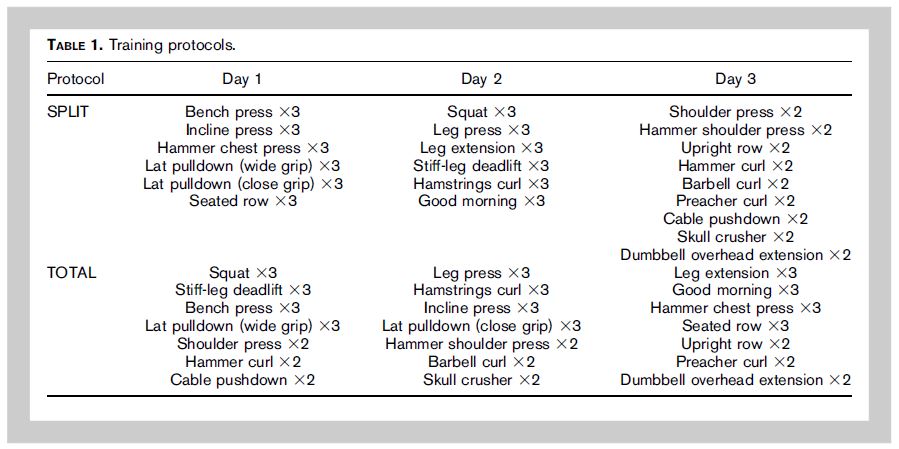
On a total body training day, I found I could do 7 exercises at most, sometimes skipping triceps and only doing 6. Interestingly, In Brad Schoenfelds study where he compared total body training with body part split training this is exactly how many exercises participants did when they were doing the total body training. It is is obvious, one exercise per body part and using the classic bodybuilding delineation of body parts and you have 7 exercises (unless you are the type of person who does a calf, forearm and abductor exercise as well).

What does the science say?... Not much.

I can't find any research that shows how many exercises per body part is best. The advice is generally common sense, hit the muscle from multiple angles and do a variety of exercises.

But you may be thinking, if I have do 10 sets for an exercise, couldn't I just do 10 sets of 10 reps of one thing like a bench press in one workout and then be covered? You would basically be doing German Volume Training(GVT) which seems to get re-discovered every year.

After a while I think this type of training would get boring, draining and you are hitting the muscles from the same angle all the time.

Redundancy.

At the other end of the spectrum you could be thinking, could I do 1 set of 10 different exercises. Here you face two problems, you don't really do an exercise enough to get good at it or know what is the best weight to use and you could end up doing a lot of sub par exercises, and secondly redundancy.

This is where you are essentially hitting the muscle with different exercises which basically do the same thing, you are not optimizing the muscle stimulation. For example, if you do barbell bench press, DB flat press and machine chest press, you are doing a very similar horizontal pressing move for all three exercises.

However, if you did incline DB press, flat DB press, pec flye and possibly a press up - you will be hitting the muscle from different angles and with different actions. You could do all these in one workout if you have a dedicated chest day or if you are hitting a muscle multiple times per week you could do 1 or 2 of these per workout. This way you will find you can lift more, for example, a pec flye after 2 other chest exercises will involve lifting less weight than if it is the only chest exercise you do.

Different body parts, different approach.

The number of exercises you do will depend on the body part. For example, for back you are looking for at least a vertical pull and a horizontal pull (row) to hit different muscle groups.

If you look at the way muscles fibres run (see the picture of the trapezius) and if you want to be fancy use the word 'pennation', you can see that some muscles are not going to be fully worked with one exercise.

Look at the different way the muscle fibres run on the trapezius, the  'pennation' if you want to get fancy. How many exercises do you need to train all of them?


The shoulders are another classic example, with 3 deltoid heads, and the rotator cuff muscles and the trapezius, you could do 4 or 5 exercises which don't have much crossover.

Whereas with biceps and triceps, quite a few people over do it, considering these muscles are also being worked with chest, back and shoulders. Even, when I did a dedicated arm workout I only managed to do 3 bicep and 3 tricep exercises.

How far do you want to go?

How many exercises you do is also dependant on how far you want to go. Glute/booty/ posterior training is very much in vogue at the moment. In the past you may have done a quad exercise, a hamstring exercise and possibly a calf one.

If you are doing 10 exercises for these muscles you are either in an LBT class or Brazilian.


But you could do a hamstring exercise for knee bend, a hamstring exercise for hip extension, glute exercise for hip extensions, adductor, abductor, quad multi joint, quad isolation knee extension only, calf gastrocnemius, calf soleus. And that's only one exercise per body part, before you know you can be doing 10 plus exercises and be in the gym 2 hours. Which begs the question of how intense you training is?

Nuts and Bolts: Strength hybrid, pure hypertrophy, circuits.

In my recent experimentation (and as I said in part 1, no it's not a real experiment) I have gone pure hypertrophy, eschewing the big compound lifts and low reps.

But if yo want to do a more strength hybrid split, powerbuiding approach or something like Wendlers 531, then the split would something like this:

Day 1:
Squat 5x5
RDL 4x8
Accessory work: Walking lunge etc

Day 2:
Bench press 5x5
Row 4x8
Accessory work: DB incline press, seated row etc

Day 3:
Deadlift 5x5
Bulgarian split squat 4x8
Accessory work: Leg curl etc

Day 4:
Military Press 5x5
Pull Up 3xmax
Accessory work: Lateral raise, rear delt etc

Generally as you go into the strength range you have to do less exercises because it takes so much time, as anyone who has ever done the Olympic lifts know. 10x2 with 2 mins rest and set up, and before you know it one exercise has taken 25-30mins. Add in some mobility work, warm up sets and you'll be lucky to get 2 exercises in a 60 minute workout. And it is very taxing.

Whereas, 3x10 with 30-60secs rest takes less than 5 minutes per exercise, hence you can do more at a lower percentage of 1RM and it will be less systemically fatiguing.

In circuit training you could easily do 10 exercises, but I would not call this hypertrophy training in the purest sense.

3 exercises will do it: What the science inadvertently shows.

In a study I really like the design of Schoenfeld et al (2014) compared 7 setx x 3 reps and 3 sets x 10 reps training schemes. A strength group and a hypertrophy group both training to failure. Both groups were experienced trainees.

A few things stand out from this research:

1) Both training schemes resulted in hypertrophy
2) They were both only doing 3 exercises per workout but still got results (increased muscle mass in the biceps). They either trained using a total body scheme, 1 push, 1 pull and 1 leg exercise per workout for 7x3 or for hypertrophy 3 exercises per body part; a day consisting of three chest exercises, another day three back exercises, and a day of three quad exercises. Note, no isolation exercises for the biceps.
3) The 7x3 group took over an hour to complete their routine whereas the 3x10 group took only 17 minutes
4) The strength group got more general fatigue and mental fatigue. Strength training day in day out is hard to maintain for weeks on end.

This echoes my own experience of strength training with no variation in volume or rep ranges. You begin to ache, start to get injured and breakdown. Strategic planning placement of higher rep work and deload weeks should stop this.

A 17 minute workout is highly achievable and means you could add in more volume or another body part such as biceps. Plus you could easily repeat this session more than once per week, thus hitting every body part twice and getting twice the volume of 18 sets per muscle.

There is also a certain amount of personal preference here and what you respond to. Personally, if I do 10x2, 7x3, compound exercises, I get stronger but my muscle mass does not increase. Eventually if I try to go heavy on things like barbell bench press and deadlift I break down.

If I want to increase muscle mass and generally not break down I have to keep in the higher rep ranges, towards 10-12 reps, and even some higher rep work. And I find isolation exercises work for me as well.

Where does that leave us?

A brief survey by me in the gym and online showed that 99% of people train using some kind of body part split. With most people doing a class Chest & Tri's, Back & Bi's routine. Most people were doing about 3 to 4 exercises per body part and 1 or 2 for muscles like biceps and triceps. Th exception being younger people, some of the younger guys doing 6 exercises for chest and one girl doing 11 exercises on leg day! Possibly younger people can get away with more volume, or they have to lower the intensity to complete these marathon routines and therefore don't get enough stimulus for growth.

Here are some example routines from my training diary. The actual exercises are not important at this stage (I�ll get to that in another post), at this stage I�m trying to give an idea of how many exercise per body part.

Chest & Triceps
Incline cable cross press
Incline press plate loaded
Cable flye high to low
Pec flye machine
Tricep tall kneeling rope press
Cable kick back

13 sets for chest, 4 exercises

2 exercises for triceps, 5 sets

Core: stir the pot

Back & Biceps

Incline bicep curl
Seated Cable row
Meadows stretcher
Diverging latpulldown
DB Pullover
Drag curl

Back 4 exercises, 13 sets,
Biceps 2 exercises 6 sets

Legs

Hack squat
Leg curl machine
1 leg mike boyle pistols
Nordic hamstring curl
Hanging leg raise

2 exercises 7 sets quads,
2 exercises 7 sets hamstrings

Chest & back & Triceps � would be repeated again in the week

Flat DB Press
Chest Supported Row
Cable Flye
McGill side pulldown
1 arm rope pushdown
1 arm cable kickback

2 exercises chest  6 sets
2 exercises back 6 sets
2 exercises triceps 4 sets

Push � Shoulders, Chest, Tricep

Flat DB Press
DB Arnie Press
Bottom to top cable crossover
Lateral raise
Pec Dec
Rear delt
Overhead tricep ext

3 chest exercises 9 sets
3 shoulders  9 sets
1 tricep 3 sets

Arms only day

DB skullcrusher
Incline DB curl offset grip
Drag curl
Kneeling bench supported tricep ext
Kneeling bench supported bicep curl
Rope over head tricep ext

3 exercises biceps, 3 triceps,
9 sets each

Total Body routine

DB Chest press
Seated Row
Barbell bicep curl
Lying leg curl
Goblet squat
Lateral raise

1 exercise per bodypart, 3-4 set each body part, 3 or 4 different total body routines per week = 12-16 sets.


Of course, these are just some random entries from my training diary and don't give you an actual routine to follow. It's not meant to be the ideal training programme in any sense, after all I was experimenting.

They don't show what rep ranges I used, they don't show what techniques I may have used such as rest pause, descending sets and so forth. Or how to fluctuate the volume, you might deliberately over reach for a couple of weeks on a body part and do multiple exercises, and get 18-20 sets and train 6 x week. And then you might back off for a week with some total body training session and train only 3 x week with only 1 or 2 exercises for a body part and 10 sets total, in the hope you would super compensate.

In summary.

The research is scant and says to hit muscles from multiple angles

Most people naturally gravitate towards 5-7 exercises per workout unless they are doing strength training or circuits.

3 to 4 exercises for big muscle groups and 2 to 3 for smaller muscle groups per workout is about the maximum you can do. Anymore than this and I find your intensity and focus would start to suffer. If you are doing 5 or 6 exercises per bodpart per workout there will probably be redundancy and replication.

The art is having enough exercises and variation for stimulus, but not so much that it is no longer optimal.

Next time.

In part 3 of this I will cover what rep ranges to use, how long to rest and those special training techniques like rest pause (extended sets) and descending sets.


Tuesday, December 6, 2016

All the broken people. Where do they all come from?

The market the fitness industry missed.

Anxiety, depression, diabetes(type 2), hip replacement, knee pain, knee surgery, knee replacement, wrist pain, wrist surgery, elbow pain, elbow surgery, shoulder pain, shoulder surgery, COPD, high blood pressure, parkinsonisms, MS, cancer, back pain, back surgery, osteoarthritis, rheumatoid arthritis, ankylosing spondylitis, osteoporosis, high blood pressure, asthma and stroke.

Above are a list of conditions, off the top of my head, that I have come across in my time in the fitness industry. Most of them I encountered in a non exercise referral situation, i.e. they joined the gym or a class and walked in, not as part of a specialised scheme. (And full disclosure, I have some of the things listed above as well!).

There are no special populations.

The fitness industry and fitness qualifications still talk about special populations.

As I've said before, there are no special populations anymore. The special population is the person who walks into the gym or a class with no injuries or medical conditions. Unless you are training a group of 19 year olds, this is probably never going to happen.

Referral schemes never quite cut it.

There was a time, 10 years ago or so, when anyone with one of the above conditions would come through an exercise referral scheme, they would have a GP referral letter, and normally they would be older, had never exercised before and exercise had become the last resort of the medical profession.

Adherence with this group was normally low, and finance was a typical barrier. I'm not saying there weren't some success stories, and some peoples lives were changed. But it has never quite achieved what it could have.

GP referral 10 years ago: Look you can sit down and watch TV, just like at home. If you have an injury or medical condition you do NOT have to use this.


Now, people with injuries and medical conditions are not coming through referral schemes. They are coming to standard classes and gyms. They are bypassing the medical profession.

On the one hand it is a positive thing, this population is more self motivated. Typically they may have been exercising for the whole lives. We are now seeing the baby boomer generation and younger, the ones who have always exercised. They have been coming to classes for 15 to 20 years and they aren't stopping now.

Teach a standard aerobics class, total body toning class with 20 people in, and you may be dealing with 20 different types of injury and medical condition.

Sometimes the participants wont tell you they have these conditions, or tell you half way through or expect you to have a plethora of modifications ready for them. I think some members of the public think you have been taught all these modifications. What is actually true: the instructor is using their experience and making their best guess at that time...

For example, I have covered LBT and toning classes where people have said to me lunges hurt my knees" or "squats hurt my knees". This would beg the question, what were you expecting to be doing in an LBT class? My standard response is, if it hurts don't do it, and maybe you should go and see a physio or get a one to one session with some health professional to sort out your knee problems before you come to a mainstream class?

Yes, we need to educate the public, but we also need to educate ourselves.

GP Referral, Level 3 PT, level 4 something.

In the UK most personal trainers have the standard level 3 qualification. And most specialised qualifications for exercise referral are level 4.

The standard level 3 personal training qualification doesn't prepare the student for all the health conditions they are going to encounter and nor in fact do the level 4 qualifications.

It's not the fault of of the well intentioned people paying the money to do these courses. As far as they are concerned this is the industry standard qualification they need.

When I did the GP referral qualification we spent a lot of time working out VO2 Max percentages, which I have never used ever again, and learning the stages of change model, which again is not that useful when faced with someone who has had a hip replacement. Then we went through all the medications for blood pressure and their side effects.  The amount of time spent on specific exercise was minimal.

The level 4 back pain specialist course I went on suggested playing bingo sitting on a swiss ball was a good thing for people with back pain (true story!). I learned more from reading McGills books. The course gave me precisely zero tools to use with an active person with low back pain.

Now, this was fine back in the day, when the referral clients you were seeing were sedentary individuals, and frail old people. In these cases, the axiom, of any gentle movement is going to be good holds true. And yes we should still help these people.

But what happens, when faced with the highly motivated individual who has had a hip replacement or knee surgery and has been discharged by the physio service who turns up for an orientation.

They have signed the waiver form saying they are good to go, and then they spring it on you.

Or you are about to do some hip moves in a pilates class, and one of the participants say "I've had a hip replacement, can I do this, what can I do instead?" They think you have been taught what to do in this situation...

Of course, rule 1 is do no harm. Rule 2 is educate yourself, because the fitness industry system of qualifications has let you down. Rule 3 is be honest.

Quick fixes.

People want quick fixes and quick answers. Instructors, how many time have you been sitting in the gym and someone comes up to you and says "what can I do for this shoulder pain I have or back pain or knee pain?". Have they seen a physio? Sometimes yes, mostly no. When you say maybe they should go and see one, they look disappointed that you didn't give them the magic shoulder exercise that will fix them after you have assessed their shoulder with your MRI/ X ray vision.

The honest answer of course is "it depends", I will have to do an hour assessment to figure out what is best for you, it costs this amount... can be met with disbelief. They are used to the quick answer, they are not used to someone saying maybe this class isn't for you right now. They are used to fitness professionals bluffing or feigning expertise.

But mostly they are used to the fitness industry ignoring their needs.

Insular. Lost markets, lost people, lost opportunity.

A vast number of the public feel excluded by fitness and gyms. "It's not for them."

And yet the Academy of Medical Royal Colleges calls exercise

"The miracle cure."
We have become an insular industry, "get ripped", "get shredded" messages, with increasingly hardcore messages about HIIT, and high level exercise that appeals to 1% of people (our fitness friends) and not the public.

At the other end of the spectrum, google "GP referral" or "exercise referral" and its the usual images of some white haired pensioners in their 90's waving their arms around in a studio, or a doctor with a stethoscope.

Or the classic gym marketing image of a trainer next to someone on a swiss ball that appeals to precisely no one.

The woman or man in his/her 40, 50's or even 60's doesn't associate themselves with 'old persons exercise'. The want help and advice, they don't want to be treated like "old people".

There is also a race to the bottom, to provide the cheapest gym with no support.

At the same time there is a race to the top to be the exclusive PT, strength & conditioning, high cost facility. (Where in fact the trainer still only has the level 3 PT qualification everyone has, and if you turn up with an injury or medical condition or an athletic goal you are going to get exactly the same workout).

And the people with a few injuries, niggles, maybe a medical condition or two but who want support and don't feel old or broken are left out.

No one is broken.

Of course, if everyone is broken, no one is broken. People are just people. Life happens.

As a society we are at crisis point with preventable disease.

Fitness should be at the forefront of helping people and educating people.

But we are are not.

The NHS lets people down with its pharmaceutical centred strategy. The media let people down with its confusing messages.

But we are also to blame. Yes, I am talking to you REPs and Active IQ with your lack of quality courses addressing what the public and instructors need. Hold your head in shame that you think mickey mouse, poor quality, distance learning level 3 is acceptable.

Yes, I'm talking to you Universities, with your sports science degrees and sports coaching degrees, churning out graduates that have no practical knowledge of how to help unfit people.

Personal trainers don't need to be physiotherapists. But we should be the go to place for people wanting to get all the benefits of exercise.

It doesn't have to complicated. It has to be sincere, quality, evidence based, compassionate and results driven. If you're not budget or coaching professional sports people, it's all you've got.

We should be better, we should be the fitness experts. The market is waiting.

"First move well, then move often." - Gray Cook


Tuesday, March 27, 2012

Qualifications once the golden rule are now just pieces of paper*

Interlude

Where have I been? In the fitness wilderness, living on protein shakes, intermittent fasting while perfecting power club Kata's. No, In reality I've been busy & lazy simultaneously, so this is my first real article of 2012. It's been a long time coming, so without further ado, here we go.

Fitness Qualifications

This is about fitness qualifications in the UK, if you live outside the UK I have no idea how it works, but having read quite a few American commentaries on their fitness industry, it seems pretty similar.

In the last year I've seen a lot of CVs and application forms from people applying for fitness instructor jobs, studio instructor roles and more recently apprenticeships (finding an apprentice is no where near as exciting as Alan Sugar and Donald 'this really is my hair' Trump make out).

There are a whole host of qualifications including degree level sports science, and I've seen people with degrees in sports coaching and even degrees in personal training. There are level 2, level 3, level 4 qualifications, NVQs, BTECS and all sorts of names I don't profess to understand. Most vocational fitness qualifications are also recognised by an organisation called the Register of Exercise Professionals (REPs, more on this later). There are universities, awarding bodies, Active IQ (whatever that is), private companies, government funded schemes and probably about a million other pathways I don't even know about. In a word, its confusing out there.

So what is the best course to do? What is the best route to take without going bankrupt? And are any of these qualifications worth a damn?

Hard Times

One thing I can say, is the job market must be tough out there, I have received application forms for apprenticeships from people with degrees in sports science and PE (No, they can't do it, they're over qualified) as well as people who have level 2 fitness instructor and level 3 personal trainer qualifications. For another job, a part time fitness instructor there were over 50 application initially, all of which had a recognised qualification. There used to be a time, when you received applications on spec from people with no qualifications, but all of these people had an industry recognised qualification.

This means there are a lot of people applying for a small number of jobs, there are a lot of people with the paper qualifications, and there are a lot of companies churning out people with fitness qualifications.

Certificate = just a piece of paper

As well as seeing all these application forms, I have had the chance to assess the practical skills of candidates with all these different qualifications. And in a word it was disappointing, it didn't matter if they were level 2 or 3 or had a personal training degree, when asked to write an exercise program they were all equal in their lack of imagination. And I don't want to be harsh to the individuals involved, I don't expect people to turn up being fully fledged coaching experts, and after all most were just doing what they had been taught or what they thought was expected of them in a gym setting. It seems, programming hadn't moved on in the 14 years or so since I was first qualified. Regardless, of which imaginary client I gave them, whether it be an old person, a young person, a fit person, unfit, back pain, 99% of the programs were uniform in the template they followed: cardio warm up, static stretching (some rare dynamic stretching), more cardio, some more cardio, machine weights, 3x10, some more cardio, swiss ball crunch and static stretch to follow. Ok, it wasn't 'wrong' as such, but no one thought about doing 5x5, or 10x3 or free weights, or mobility/ activation drills, or not giving the person with back pain crunches. Its not as if this information isn't readily available on the internet or in book form! The average well informed gym user could probably write a better program.

To paraphrase Alwyn Cosgrove, someone comes to us and wants to lose weight, what do we do? Cardio & weights. Someone comes to us and wants to get fit, improve body composition, increase muscle, what do we give them? Cardio & weights. There has to be a bit more specificity, surely?

It also seems practical coaching skills or basic movements really don't feature much in these courses. Asking for a demo of a deadlift, or squat, or press and to coach a client was painful to watch in some cases, it was obviously the first time some of these fitness professional had attempted these movements.

Now there is a school of thought, that says, you can teach the practical skills later and the most important thing is the ability to interact with people. Which is true to a certain extent, but when you do encounter that person with back pain, or someone with real goals it's a good idea to have a vague idea of what to do. Yes, you need to be able to motivate but you also need to have the practical skill and coaching 'eye' to see how someone needs to fix their squat.

Level 2 - write down what you already know

A few people I know recently did their level 3 qualification, but they had to do their level 2 again with the training company they were using. It was following an NVQ model, which as far as I can tell, involves writing down what you already know and what you already do, so you don't have to actually learn anything new, or read anything, you're already doing the job, just write it down and get a qualification. I don't know if this is a uniquely British type of qualification. They also had to answer such questions as what do you do and who do you call in the event of a first aid, what is the procedure after an accident. All useful things to know, but the type of things a company has to tell you anyway on the first day of the job, and doesn't really help you when confronted with the obese guy with a knee injury.

So that's level 2.

Level 3

Level 3 really take it to the next level. A former employee of mine was completing her level 3 qualification last year, when I asked her how the course was going, she looked somewhat disappointed. They had been taught how to do advanced techniques like body part splits, giant sets & tr-sets. As she rightly said, this is not how I train or the women who come to me to get fit, lose weight and 'get toned' want to train. I asked if they had covered anything else like mobility drills, or total body movements, metabolic conditioning, 10x3, EDT. The answer was 'no', the advanced personal trainer course had managed to combine some crazy 'functional training'  and had lifted most of their syllabus from a 1997 issue of Flex magazine.

Level 3 personal training courses use this as a reference, but you don't even get to look at the fitness model centre fold to distract you from the poor information

So again, despite the shear wealth of information out there on training methods, even down to realising that muscle hypertrophy maybe doesn't just occur in the 8-12 rep range, the average fitness qualification will stick with some 'broscience' rather than the evidence.

Level 3 specialist courses

Now you're fully qualified its time to specialise. Exercise/GP referral is one route. I did this course quite a few years ago. The first thing you'll notice on these courses, is that there are very few people from the private sector or self employed personal trainers attending them, nearly everyone works in local authority or leisure trust centres. As these are the only real business's that have exercise referral schemes.

When I attended this course quite a few years ago now, we covered a myriad of conditions. First things first though, we went through the karvonen method of heart rate percentages, then onto working out V02 max percentages, then onto all the medications that people can take that render these heart rate methods inaccurate and worthless, then onto the Borg RPE scale (like an old friend for anyone who has attended any fitness course). Then onto the stages of change, and readiness for change model - which is pretty much useless for anyone working in a gym. And then onto the guidelines for all the conditions, which I can summarise in one line 'do an extended warm up, do some more cardio, do a weights circuit using 8-12 reps following ACSM guidelines, use RPE scale'.

This works fine for your average deconditioned client with anxiety, depression, or hypertension - you can't go wrong if you use common sense. Then you start getting referrals of people with knee replacements, hip replacements and you realise that course wasn't worth a damn. Where was the practical info on how to get people mobile again, to strengthen their hips, get them out of a chair and walking. It wasn't there, you had to go find it yourself.

Again, there is a school of thought, that I have seen quite a few physios subscribe to, that any movement and exercise is equally valid if it gets people moving. Tell that to the cardiac client who can do 40 minutes on the recline bike but still can't get out of a chair without struggling and getting out of breath.

At this point, you start abandoning official fitness courses and go looking elsewhere for the answers.

Level 4 and beyond

I have done two level 4 courses, one for exercise for lower back pain management and one for exercise for stroke.

The back pain was somewhat farcical. The course text was Stuart McGill's book Lower Back Pain Disorders, which I had read before attending the course. It turns out the physio taking the course hadn't read the book. First there was a question paper, where me and my colleague (Nick 'contest ready' Heasman) both had the same question marked 'incorrect' by the physio tutor, in fact we had got the question right (what provides the core with hoop strength? Rectus Abs or transversus? You decide) and the physio was wrong.

Secondly, when demonstrating the bird dog, the physio told us to hollow and pull our abs in, when I asked why we weren't bracing like the course text said, it turns out the tutor hadn't read the text, and gave the usual blah answer that I can't even recall it was so absurd. We then learnt some useful things like, playing bingo (I kid you not, forward flexion intolerant, don't worry a game of bingo will make you feel better) to help people overcome the psycho-social aspects of back pain (tell that to an athlete trying to get on the field or the young mother with kids) and then the usual 'cop out' of its non specific chronic back pain, then any movement should help. To paraphrase Stuart McGill, there is no such thing as non specific back pain, they just haven't investigated it properly.

To add to the farce, it turned out this course wasn't accredited level 4 when we did it, so we then had to go and re-do it, with a case study, practical demo and a heavy emphasis on yellow flags and psychosocial aspects (important, but not the only thing like most of these courses seem to assume). The Active IQ framework for exercise for back pain was the usual - cardio warm up, stretches, pulse raise blah blah. When my colleague pointed out to the assessor you probably wouldn't use this format with a back pain client he agreed.

At this point you may think I was losing faith in the fitness courses.

I also did the exercise for stroke course with later life training. Another level 4 course, this one was all evidence based for stroke. As usual there was only one self employed PT on this course, everyone else worked for local authorities & leisure trusts.

Though this course was comprehensive, the evidence based circuits was literally based on one study. So we had to replicate the circuit used in the study exactly. This is a somewhat problematic approach to evidence based programming, as there is only one source and you are doing things that were done within a limited research setting. If they had drawn on more evidence base and given a template or blue print to follow rather than having to do exactly the same exercises and warm ups and stretches in the same order the course may have been more applicable. Even blending in some clinical wisdom, and common sense with the evidence base may have made the course more practical in the long term.

And it also begs the question, who cares if you are level 4...

REPS

The register of exercise professional classifies fitness courses as level 2, 3, and 4 and its members can be level 2,3, or 4.

Again, showing the bias of level 4 courses, to become a level 4 instructor on REPs you need to have reference from your employer and do some online test on the quality assurance referral framework (eh?). Thus they assume you must be employed, you can't be self employed it seems.

And most strikingly, no one cares if you are level 4 REPs, no one will ever ask you if you are level 2, or level 3 or level 4. Not one client ever has asked me if I am a member of REPs or what level I am.

Much like being a level 45 dungeon master, no one cares if you are REPs level 4.

Craig Feldspar level 45 dungeon master: Much like being level 4 REPs, no one cares


Clients don't really care who you did your course with or what level you are. They look at how you behave and how you train people and what results you achieve.

There is a long held belief by many in the fitness industry that REPs is nothing more than a glorified way of training companies getting you to do more courses. I don't think they're in cahoots or its a cartel or anything, but REPs needs the training organisations and the training organisations need REPs. The REPs newsletter and email bulletins contain adverts for courses by training providers.

Fact is, you don't need to be a member of REPs, no one cares, as long as you are insured, belonging to this organisation wont get you any more business.

And the training courses; I was lucky my level 4 courses were paid for by other organisations. If I was paying for them myself I would think long and hard before doing them, if you are genuinely interested in the subject, then do them, but they won't increase your income potential, you might as well do Zumba or British Military Fitness if you want to do that.

What now? Read a book

At this point I can only echo Nick Tumminello's advice, if you want to do a fitness course, do the cheapest and quickest one you can.

Then forget most of what they told you and go and read a book or two and look for good sources of info on the internet, DVDs etc. When I first started back in the dark ages, none of this was available, you had to do courses, now you can learn more in a week than a year of courses.

I get asked all the time, which is the best course to do, and it really doesn't matter, I don't think any of them stand out. I've learnt more from the internet, books, DVDs, research articles. I would say that 99% of what I do now on a daily basis with clients I did NOT learn from a training course.

If you have a qualification, you will probably get an interview - depending on how much effort you put into your application form. But make sure you can demonstrate an exercise, that you can write a decent program. And most importantly, if you want to work for an organisation go and do some research on member retention, customer service and how to talk to people. For some reason, none of the courses out there cover this.

Feudal Japan

These days, getting a fitness qualification is easy, and without getting too political, most qualifications in this country are now easy. There is no real failure rate, there is no gold standard qualification.

Back in the day, in  Japan, there are the famous stories of a student waiting outside a masters house for weeks in the snow before being accepted and then doing years of menial tasks. They had to show real dedication and commitment to the subject and put the time in. Now I'm not advocating this type of medieval training, but we need to raise the standard. It can't be a free for all, with thousands of people getting worthless qualifications.

If we have no faith in the qualifications, nor will the public.

In the meantime, get the piece of paper you need, but then be true to yourself, and spend a life time learning and mastering your subject, you owe it to yourself and your clients.

A picture of Ava Cowan to make us all feel better: now this article is better than Flex magazine and most training courses!


*The title for this blog was stolen from the Billy Bragg song To Have And To Have Not