Tuesday, March 21, 2017

Experiments in Hypertrophy: Part 3 - Reps, Rest and Tempo.

In parts 1 and 2 I covered the best training splits and how many exercises to do. For part 1 and part 2 go here and here.

Note: if you don't want to read the whole post, skip to the bullet points at the end which tell you everything you need to know.

Rep Ranges.

The classic hypertrophy rep range is 8-12. Most guys (and women) training for mass spend the majority of their time in this rep range, with the occasional venture into the strength range of 6 or less during winter bulking phase and into the higher 12-15 'endurance' range when getting ready for summer.

But some athletes appear to increase muscle mass and never go near the 8-12 range. For example, Olympic weightlifters are normally way below this and Crossfitters are normally near maximal or doing some crazy high rep range (55 rep deadlifts anyone?).

So what does the research show. Previously in part 2 I outlined Brad Schoenfelds research where one group did 7x3 and another 3x10 and basically got the same results and improved muscle hypertrophy. However, the 7x3 workout took more than twice as long as the 3x10 and the strength group started to break down and complain of overtraining.

In a follow up study Schoenfeld et al (2016) did something interesting, they compared 3 sets of 2-4 reps with 3 sets of 8-12 in experienced lifters. This meant there wasn't a big difference in volume, 3 sets of 2-4 is achievable. Both groups did 7 exercises to failure in the prescribed rep range with 2 minutes rest between sets. They measured the cross sectional area of the triceps, biceps and lateral thigh before and after the 8 week trial. There was an increase in biceps in both groups but not much difference, an increase in triceps in both groups but not much difference and an increase in lateral thigh in both groups but a statistical significant difference between groups, with the 8-12 rep range working best. So even though the study shows moderate 8-12 rep range to be better, both schemes increased cross sectional area and when you look at the raw data it is really not that much different. The authors put some of the strength groups success down to the novelty of changing the programme, as most participants were training 8-12 before the trial. Unsurprisingly the group training heavy increased their squat 1RM the most as well.

But what about high reps?

Two studies stand out showing very high rep ranges, Schoenfeld et al (2015) compared 3 sets of 8-12 reps with 3 sets of 25-35 reps, using 7 exercises, 3 times a week.

Both rep schemes significantly increased the cross sectional area of the biceps, triceps and quads. There was no significant difference between the groups. None of the high rep group had lifted with this many repetitions before despite being experienced lifters. But they were experienced, this was not 'newbie' gains. It could be they were targeting the type I endurance fibres, whereas normally they would be targeting the same fibres all the time - the type II ones.

But don't be fooled, very high reps to failure is taxing, as Schoenfeld says "half the subjects in the low load group puked during the first week of training"!!

And in another study by Fink et al(2016) which was actually about rest periods (which I will get to later); they were using 4 sets of 40% 1RM for squat and bench press to failure,  in non experienced lifters (but involved in sports). All the participants showed significant increase in cross sectional area for triceps and thighs and they all increased their 1RM! The cross sectional increase was 9.8% and 10% in the triceps in both groups in the study. The paper doesn't say how many reps they were doing but the authors say it didn't drop below 12 even on the last set and using their data I have worked out the rep ranges would have been between at least 19 and 36 per set!

The authors say that low load training (less than 30% of 1RM) may cause a prolonged period of post exercise muscle synthesis compared to 90% 1RM.

We know that muscle growth is due to a whole range of factors such as mechanical tension, metabolic stress, chemical release, hormones and more.

In this case the conjecture is high reps may result in sarcoplasmic hypertrophy, so called non contractile protein and fluid. For the average gym jock, this makes no difference. Mass is mass.

Where does this leave us?

From personal experience low strength reps don't increase muscle mass that much in me. But the mass it does produce is qualitatively in my opinion denser and more likely to be the functional strength and power fibres. What is known as myofibrillar hypertrophy. I respond best to higher reps for hypertrophy.

In reality, for most trainers the rep range will vary with the exercise. For example, no one is going to try a 3 rep max rear delts flye, but a 15-25 rep rear delt flye seems reasonable. The same could be said for calves, if you are going to train them. This then comes down to the old adage about different parts of the body having different fibre mixes, if the calves are mainly type I endurance fibres then high reps would work best. Conversely, no one is probably going to do 3 x 35 reps for pull ups, so the exercise itself makes you go into moderate rep ranges.

Some things intuitively don't make sense, for example, if you do 35 reps of deadlifts you are inadvertently doing Crossfit. Whereas, 35 reps of a bodyweight 1 leg glute thrust would work.

The research does seem to show the benefits of high rep squats increasing muscle mass, see my post here on high rep squats. This is a taxing exercise but well worth putting in occasionally.

Exercises like cable flyes and machines lend themselves to high reps 12-15 whereas I think things like your classic dumbbell bench press are better in the 8-12 rep range.

I also like timed sets, set a stop watch for 35 or 45 or 55 seconds and then see how many bicep curls or press ups you can do with controlled tempo. This type of training keeps you honest!

I think many guys avoid high rep training because it is hard and burns, plus you have to leave your ego at the door and venture over to the chrome dumbbells.

Could you use interval endurance/ training?

Given that very high reps of 35 have caused hypertrophy could you not use sprint intervals on a bike or rower or ski erg or hill sprints to increase muscle hypertrophy? If the intervals are all out intense 10-20 seconds I can't see why they wouldn't work. The size of track cyclists legs is probably a testament to this.

I would also think exercises like prowler pushes could result in increases in muscle mass and strength depending on load and timing.

The perfect rep.

One thing I have really being trying to do over the last few months is feel every rep.

It doesn't matter what rep scheme you use if all your reps are crappy.

Really try and feel the muscle you are working on every rep. Let go of the ego of the weight, there is always the temptation to try and move up to the next set of dumbbells on the rack. Before you know it, you are going partial range and cheating the weight up.

Although there are times when partial range may be beneficial such as when doing 21's, in most cases go full range.

Also note in all the studies above they make the participants go to failure.

Lift with focus and intensity!

How long to rest?

The research is not consistent on this issue.

Schoenfeld et al (2015) compared resting 1 minute versus 3 minutes when training 3 sets of 8-12 reps. This research actually showed resting longer was more beneficial for hypertrophy. The authors state that in the long rest group "muscle was significantly greater in the anterior thigh and a trend for greater thickness in the triceps brachii"

However, when you look at the actual data from the study, there is not that much difference between groups. And as the authors state 1 minute is probably too short but 2 minutes would be long enough.

The difference in the anterior thigh would makes sense. As anyone knows, leg exercises such as squats are systemically taxing and need longer rest than some upper body exercises. A tricep kickback might only need 30 secs rest.Therefore, regional hypertrophy in the body may mean different rest periods (and rep ranges) for different body parts and different types of exercises.

Schoenfeld et al state

"Longer rest periods can allow for the completion of a higher number of repetitions and the maintenance of a higher training intensity and volume, and this may allow for greater muscle activation per set."

However, another researcher studying elderly men (average age 68) found a 1 minute rest period was better than a 4 minute one, and resulted in greater gains in lean mass and strength.

And don't forget how much longer it takes to rest an extra 2 minutes per set, that would be an extra 6 minutes per exercise for 3 sets, and an extra 42 minutes if you do 7 exercises. If you used those 40 minutes to do additional exercises and sets with less rest would you get better results?

And could you not maximize time efficiency with rest by doing supersets and if you are alternating limbs, say in a tricep exercise, one side is resting while the other is working?

High reps need less rest.

In a study already mentioned, Fink et al (2016) compared resting 30 seconds with resting 150 secs when lifting 40% 1RM squat and bench for 4 sets.

Both groups got increases in muscle mass and strength, with no significant difference between groups. And the blood work showed the metabolic stress for both groups was the same.

This shows that when doing very high reps, 20-35 - then you can rest less. Caveat being if you have ever tried to rest 30 secs between high rep squats you will blow up or throw up.

Where does this leave us?

Most studies that are not testing different rest periods seem to use 2 minutes.

In reality now I do not measure rest periods, by the time you changes your weights over, take a sip of water, write in your training diary what you just did you will be ready to go again. This means I am probably resting about 60-90 secs at most and no where near 3 minutes. The difference between resting 2 or 3 minutes is very marginal and other factors come into play

If you are mainly interested in strength, definitely rest longer.

Supersets are a good way to maximize rest efficiency, for example superset a dumbbell row with dumbbell chest press.

In my opinion, isolation exercises like tricep extensions and high rep exercises like rear delt flyes will need very little rest, 30 secs, legs will need more.

The caveat is special training techniques like descending sets and rest pause, where rest may be 10 secs or less, which I will cover in part 4 of this series.

In my experience, most clients and women will not rest enough when you are training them, they will rest a few seconds and try and go again. This means you need to educate them and make sure they are going to real failure!

Tempo.

There was a time when tempo was big, mainly because of Ian King and Poliquin programmes. You would see things like 51X0 and 3111 written on programmes.

Normally referring to how fast you should lower a weight, eccentric, then concentrically press it up and may be squeeze and hold a peak contraction.

This seems to have fallen out of favour recently. I would imagine probably because when you are trying to focus on perfect reps and counting to 15, the last thing you want to do is try to count exact tempo as well.

The caveat would be triphasic training, this is using eccentric, concentric and isometric contraction in a specific way. For an explanation of triphasic training go here, and how to apply it here.

The eccentric phase is the part of the movement causing muscle soreness. Sports like Olympic weightlifting and track cycling do not have much eccentric loading of muscle but can still result in muscle mass. (Yes, I'm aware these groups may do some training use eccentric loading and possibly have chemical assistance). Soreness is not necessary for growth but we all like the feeling of DOMS!

In most of the studies I have read they normally get the participants to do a 2 second eccentric and 1 second concentric. This would seem about about right, I would probably go closer to 3 second eccentric and possibly a 1 sec squeeze on things like latpulldowns , with an explosive but controlled concentric. But I wouldn't spend too much time thinking about this.

Of course, I am talking specifically about hypertrophy training here. Strength and power are different.

One thing I would avoid is super slow training, this seems pointless to me, as do super slow concentric phases.

No studies involved women!

Its important to note that none of the studies cited used women. It was the usual young male college student in most cases.

Would women respond differently to high reps, and different rest periods? Who knows. Someone needs to do that research.

Take away points.


  • You can increase muscle mass in all different types of rep ranges, 2-4, 8-12, 25-35
  • Moderate rep ranges are probably better than lower reps for hypertrophy.
  • Keep most of your training in the 8-12 rep range for hypertrophy but..
  • Try some high rep stuff, its hard, and occasional strength work. In other words periodise and vary. Leave your ego at the door, the chrome dumbbells are calling you!
  • You could try 3 total body sessions a week, one strength 3x2-4, one moderate 3x8-12, one high rep 3 x 20-30. 
  • Different exercises lend themselves naturally to different rep ranges and rest periods. 
  • Try some high reps squats!
  • Different body parts can be trained with different rep ranges and rest periods. Rest longer on legs.
  • Rest period, if you are an experienced lifter self selecting will work best.
  • Rest 30-45 secs for small body parts/isolation work and very high reps.
  • Rest 90 to 120 secs for compound movements, legs and taxing exercises.
  • The benefits of resting 3 minutes is marginal at best for hypertrophy and very boring and time consuming. If you have time give it a go and see if it makes a difference.
  • Tempo, don't get obsessed, slow eccentric 2-3 secs, fast concentric, squeeze hold where you can.
  • To increase 1RM do more work in the 2-4 rep range, and rest longer. Bizarrely your 1RM will also increase if you do high rep training with minimal rest.
  • Go to failure at some point. Not on every set, but definitely on some of your work sets.
  • Think about executing the perfect rep and feeling the muscle working probably trumps everything else for hypertrophy.
Next time special techniques - rest pause, descending sets and more.


Tuesday, March 14, 2017

Coaching Ethos.

How do you create a high level coaching team?

This is a question I think about a fair amount.

These are my thoughts after talking to people who have been in high level coaching teams, observing how organizations like the NFL work and reading some of the literature.

Much of the literature and most of the books are about teams within business organizations. Some of this applies to the 'actual' coaching fitness professionals do. Some of it applies to professional sports teams, but is not so applicable to paying clients. I think it was Mike Boyle who said it is way harder to coach the general public than professional athletes.

I am also assuming you are not a lone personal trainer, in which case you are the coaching team, and should build a referral network for things that may be beyond the scope of your skill set at this moment such as nutrition and sports injury. Unfortunately, many lone personal trainers do not do this, to be blunt they need the money and therefore try to be an expert in everything. Sometimes this works out for them, sometimes it doesn't.

So without further ado in random bullet point format (easily tweetable).


  • Everyone in the team knows their exact role.
  • Everyone knows the exact goal of their team and their part in it.
  • Everyone needs to know the product. Yes that includes the cleaner and the receptionist working one hour a week.
  • Clear metrics on what we are measuring. What is important to us.
  • Consequences for not meeting the metric.
  • Reward for meeting the chosen metric.
  • Regular coaching get togethers. Make the agenda clear, not moaning and gossip. But plans and solutions.
  • Every day, week, month think what did we do well, what could we do better/different. And then act on this.
  • The coaching team should complement each other. They don't have to be clones.
  • Make it clear to customers and clients -'this is what we do'.
  • Make it clear to customers - 'this is not what we do' but we may know someone else who does.
  • Don't try and bend the product to the customer.
  • But be flexible with your product, if the market and the science and the zeitgeist changes you may need to change. But make that change whole hearted, not piecemeal.
  • If the client is willing to work hard, or the customer is a promoter, go all out and give everything.
  • Sack the customer who doesn't want it. Sack the customer who annoys other customers.
  • The basics that every customer expects - clean, equipment works, greeting, acknowledgment from staff.
  • Clear pricing, clear proposition.
  • Don't be afraid of your price if the product is worth it.
  • USP, it could be weightlifting, or rehab, or beginners, or weightloss, or being cheap or group training or being luxury. Choose what it is and embrace it.
  • Let the USP inform every level of your product from marketing, social media presence, staff recruitment to layout of the building or the equipment you choose.
  • Amateurs come across as amateurs. If you are a professional this is how you make your living. It should be all consuming. For amateurs it is a hobby, professionals get paid.
  • None of your team should come across as amateurs. Again this applies to the cleaner, the receptionist and the back room staff.
  • If half your salary depended on retaining members and customers what would you do differently? (Self employed people already get this). Who and what would make the cut?
  • If you are new to the market you may need to discount to get your name out there.
  • If you are established and still discounting there is either something wrong with your business model or your pricing is wrong.
  • Don't phone it in.
  • If you've got nothing on the line what have you got to lose or gain? Managers of big organizations find it hard to grasp this.
  • Your coaches should be constantly learning and training. What does the team actually want to improve at? Organize that training for them
  • What does the team need to improve at, organize that training for them.
  • Everyone should be improving and engaging in deliberate practice. In-house training and external training should be built into the schedule and built into the budget, not an after thought.
  • Use scientific rigour to inform your coaching, but also realize that coaching is an art that requires creativity.
  • Be honest.
  • Be open. Other people can have really good ideas.
  • You don't need to be the expert in everything, but know someone who is.
  • It should be fun. But that doesn't mean it shouldn't also be serious, challenging  and sometimes stressful. Being good at something is hard. being the best is really hard.
  • Listen. If no one is saying anything, you are in trouble.
  • Passion only gets you so far, eventually you need a plan, skills, grit and dedication (cue Record Breakers theme tune from the 1980's with Roy Castle on his trumpet, outside of the UK this reference doesn't mean anything)
1980's flashback.


Of course, all this is easier said than done.

Well, that's all I've got right now. Let me know if you have anything else to add to the list.

Tuesday, March 7, 2017

Experiments in Hypertrophy: Part 2 - How many exercises per workout and per body part.

In the second part of this series, I expand on my own experiments in hypertrophy, see what other people do and have a look at the science.

See here for part one on training splits.

Once you've decided on your training split, and you know you have to a hit a muscle with at least 10 sets per week, possibly up to 20, and optimally train it at least twice a week, then how many exercises should you do?

Assuming your workout is 60 minutes or thereabouts (excluding any cardio but including at least a quick warm up and some core at the end) I found you can't really do more than 6 or 7 exercises in a hypertrophy workout. In reality sometimes 5 is enough depending on how intensely you are training and the training methods you are using.

So, for example, on a classic chest day, this would be 3 or 4 chest exercises and 2 tricep exercises.

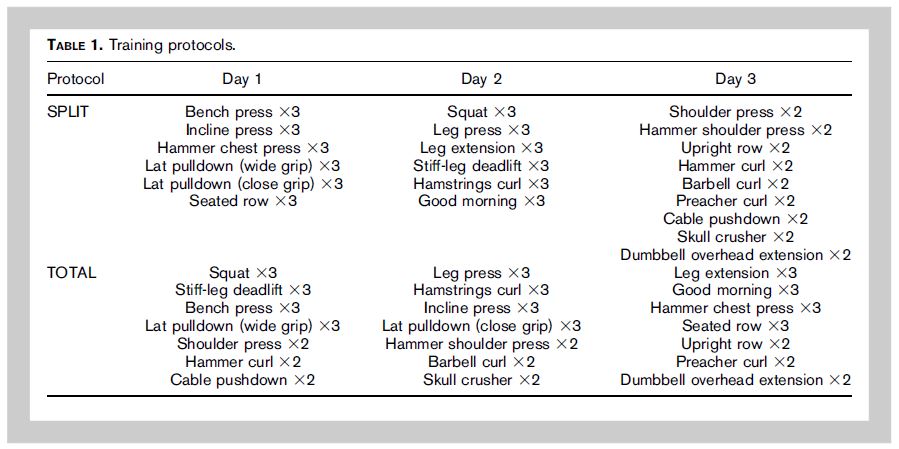
On a total body training day, I found I could do 7 exercises at most, sometimes skipping triceps and only doing 6. Interestingly, In Brad Schoenfelds study where he compared total body training with body part split training this is exactly how many exercises participants did when they were doing the total body training. It is is obvious, one exercise per body part and using the classic bodybuilding delineation of body parts and you have 7 exercises (unless you are the type of person who does a calf, forearm and abductor exercise as well).

What does the science say?... Not much.

I can't find any research that shows how many exercises per body part is best. The advice is generally common sense, hit the muscle from multiple angles and do a variety of exercises.

But you may be thinking, if I have do 10 sets for an exercise, couldn't I just do 10 sets of 10 reps of one thing like a bench press in one workout and then be covered? You would basically be doing German Volume Training(GVT) which seems to get re-discovered every year.

After a while I think this type of training would get boring, draining and you are hitting the muscles from the same angle all the time.

Redundancy.

At the other end of the spectrum you could be thinking, could I do 1 set of 10 different exercises. Here you face two problems, you don't really do an exercise enough to get good at it or know what is the best weight to use and you could end up doing a lot of sub par exercises, and secondly redundancy.

This is where you are essentially hitting the muscle with different exercises which basically do the same thing, you are not optimizing the muscle stimulation. For example, if you do barbell bench press, DB flat press and machine chest press, you are doing a very similar horizontal pressing move for all three exercises.

However, if you did incline DB press, flat DB press, pec flye and possibly a press up - you will be hitting the muscle from different angles and with different actions. You could do all these in one workout if you have a dedicated chest day or if you are hitting a muscle multiple times per week you could do 1 or 2 of these per workout. This way you will find you can lift more, for example, a pec flye after 2 other chest exercises will involve lifting less weight than if it is the only chest exercise you do.

Different body parts, different approach.

The number of exercises you do will depend on the body part. For example, for back you are looking for at least a vertical pull and a horizontal pull (row) to hit different muscle groups.

If you look at the way muscles fibres run (see the picture of the trapezius) and if you want to be fancy use the word 'pennation', you can see that some muscles are not going to be fully worked with one exercise.

Look at the different way the muscle fibres run on the trapezius, the  'pennation' if you want to get fancy. How many exercises do you need to train all of them?


The shoulders are another classic example, with 3 deltoid heads, and the rotator cuff muscles and the trapezius, you could do 4 or 5 exercises which don't have much crossover.

Whereas with biceps and triceps, quite a few people over do it, considering these muscles are also being worked with chest, back and shoulders. Even, when I did a dedicated arm workout I only managed to do 3 bicep and 3 tricep exercises.

How far do you want to go?

How many exercises you do is also dependant on how far you want to go. Glute/booty/ posterior training is very much in vogue at the moment. In the past you may have done a quad exercise, a hamstring exercise and possibly a calf one.

If you are doing 10 exercises for these muscles you are either in an LBT class or Brazilian.


But you could do a hamstring exercise for knee bend, a hamstring exercise for hip extension, glute exercise for hip extensions, adductor, abductor, quad multi joint, quad isolation knee extension only, calf gastrocnemius, calf soleus. And that's only one exercise per body part, before you know you can be doing 10 plus exercises and be in the gym 2 hours. Which begs the question of how intense you training is?

Nuts and Bolts: Strength hybrid, pure hypertrophy, circuits.

In my recent experimentation (and as I said in part 1, no it's not a real experiment) I have gone pure hypertrophy, eschewing the big compound lifts and low reps.

But if yo want to do a more strength hybrid split, powerbuiding approach or something like Wendlers 531, then the split would something like this:

Day 1:
Squat 5x5
RDL 4x8
Accessory work: Walking lunge etc

Day 2:
Bench press 5x5
Row 4x8
Accessory work: DB incline press, seated row etc

Day 3:
Deadlift 5x5
Bulgarian split squat 4x8
Accessory work: Leg curl etc

Day 4:
Military Press 5x5
Pull Up 3xmax
Accessory work: Lateral raise, rear delt etc

Generally as you go into the strength range you have to do less exercises because it takes so much time, as anyone who has ever done the Olympic lifts know. 10x2 with 2 mins rest and set up, and before you know it one exercise has taken 25-30mins. Add in some mobility work, warm up sets and you'll be lucky to get 2 exercises in a 60 minute workout. And it is very taxing.

Whereas, 3x10 with 30-60secs rest takes less than 5 minutes per exercise, hence you can do more at a lower percentage of 1RM and it will be less systemically fatiguing.

In circuit training you could easily do 10 exercises, but I would not call this hypertrophy training in the purest sense.

3 exercises will do it: What the science inadvertently shows.

In a study I really like the design of Schoenfeld et al (2014) compared 7 setx x 3 reps and 3 sets x 10 reps training schemes. A strength group and a hypertrophy group both training to failure. Both groups were experienced trainees.

A few things stand out from this research:

1) Both training schemes resulted in hypertrophy
2) They were both only doing 3 exercises per workout but still got results (increased muscle mass in the biceps). They either trained using a total body scheme, 1 push, 1 pull and 1 leg exercise per workout for 7x3 or for hypertrophy 3 exercises per body part; a day consisting of three chest exercises, another day three back exercises, and a day of three quad exercises. Note, no isolation exercises for the biceps.
3) The 7x3 group took over an hour to complete their routine whereas the 3x10 group took only 17 minutes
4) The strength group got more general fatigue and mental fatigue. Strength training day in day out is hard to maintain for weeks on end.

This echoes my own experience of strength training with no variation in volume or rep ranges. You begin to ache, start to get injured and breakdown. Strategic planning placement of higher rep work and deload weeks should stop this.

A 17 minute workout is highly achievable and means you could add in more volume or another body part such as biceps. Plus you could easily repeat this session more than once per week, thus hitting every body part twice and getting twice the volume of 18 sets per muscle.

There is also a certain amount of personal preference here and what you respond to. Personally, if I do 10x2, 7x3, compound exercises, I get stronger but my muscle mass does not increase. Eventually if I try to go heavy on things like barbell bench press and deadlift I break down.

If I want to increase muscle mass and generally not break down I have to keep in the higher rep ranges, towards 10-12 reps, and even some higher rep work. And I find isolation exercises work for me as well.

Where does that leave us?

A brief survey by me in the gym and online showed that 99% of people train using some kind of body part split. With most people doing a class Chest & Tri's, Back & Bi's routine. Most people were doing about 3 to 4 exercises per body part and 1 or 2 for muscles like biceps and triceps. Th exception being younger people, some of the younger guys doing 6 exercises for chest and one girl doing 11 exercises on leg day! Possibly younger people can get away with more volume, or they have to lower the intensity to complete these marathon routines and therefore don't get enough stimulus for growth.

Here are some example routines from my training diary. The actual exercises are not important at this stage (I�ll get to that in another post), at this stage I�m trying to give an idea of how many exercise per body part.

Chest & Triceps
Incline cable cross press
Incline press plate loaded
Cable flye high to low
Pec flye machine
Tricep tall kneeling rope press
Cable kick back

13 sets for chest, 4 exercises

2 exercises for triceps, 5 sets

Core: stir the pot

Back & Biceps

Incline bicep curl
Seated Cable row
Meadows stretcher
Diverging latpulldown
DB Pullover
Drag curl

Back 4 exercises, 13 sets,
Biceps 2 exercises 6 sets

Legs

Hack squat
Leg curl machine
1 leg mike boyle pistols
Nordic hamstring curl
Hanging leg raise

2 exercises 7 sets quads,
2 exercises 7 sets hamstrings

Chest & back & Triceps � would be repeated again in the week

Flat DB Press
Chest Supported Row
Cable Flye
McGill side pulldown
1 arm rope pushdown
1 arm cable kickback

2 exercises chest  6 sets
2 exercises back 6 sets
2 exercises triceps 4 sets

Push � Shoulders, Chest, Tricep

Flat DB Press
DB Arnie Press
Bottom to top cable crossover
Lateral raise
Pec Dec
Rear delt
Overhead tricep ext

3 chest exercises 9 sets
3 shoulders  9 sets
1 tricep 3 sets

Arms only day

DB skullcrusher
Incline DB curl offset grip
Drag curl
Kneeling bench supported tricep ext
Kneeling bench supported bicep curl
Rope over head tricep ext

3 exercises biceps, 3 triceps,
9 sets each

Total Body routine

DB Chest press
Seated Row
Barbell bicep curl
Lying leg curl
Goblet squat
Lateral raise

1 exercise per bodypart, 3-4 set each body part, 3 or 4 different total body routines per week = 12-16 sets.


Of course, these are just some random entries from my training diary and don't give you an actual routine to follow. It's not meant to be the ideal training programme in any sense, after all I was experimenting.

They don't show what rep ranges I used, they don't show what techniques I may have used such as rest pause, descending sets and so forth. Or how to fluctuate the volume, you might deliberately over reach for a couple of weeks on a body part and do multiple exercises, and get 18-20 sets and train 6 x week. And then you might back off for a week with some total body training session and train only 3 x week with only 1 or 2 exercises for a body part and 10 sets total, in the hope you would super compensate.

In summary.

The research is scant and says to hit muscles from multiple angles

Most people naturally gravitate towards 5-7 exercises per workout unless they are doing strength training or circuits.

3 to 4 exercises for big muscle groups and 2 to 3 for smaller muscle groups per workout is about the maximum you can do. Anymore than this and I find your intensity and focus would start to suffer. If you are doing 5 or 6 exercises per bodpart per workout there will probably be redundancy and replication.

The art is having enough exercises and variation for stimulus, but not so much that it is no longer optimal.

Next time.

In part 3 of this I will cover what rep ranges to use, how long to rest and those special training techniques like rest pause (extended sets) and descending sets.


Tuesday, February 21, 2017

Forming new habits. Part 4: Memory.

Every habit you have is embedded in your memory somewhere. 

For part 1,2,3, go here, here and here

The more you practice a habit, the more the neural pathways are laid down. The pathway gets stronger and the memory becomes consolidated. As the neuroscience adage says 'neurons that fire together, wire together'.

But you memory is unreliable. It does not store fixed digital files, they change over time. Less like a digital photo and more like a painting you keep adding to and re-touching. Your memory of playing frisbee at 10 years old is different when you remember it at 14 years old to when you remember it at 50 years old.

You will have attachments to certain activities and foods beyond the utility of getting enough calories to survive and filling up your days with stuff to do.

Think of all your favourite comfort foods, they will probably have a memory attached to them. A roast dinner at your grandparents, a cheese sandwich after school, being given a certain chocolate bar as a treat. That food you had once on an amazing holiday.

And you may have an aversion to other foods because of a bout of food poisoning, or that time you got so drunk on Sambuca that you can never face drinking it again.

And you cannot escape your culture.

Pepsi vs Coca Cola.


In one famous study (McClure et all, 2004) the researchers compared peoples brain activation in an fMRI scanner when they were drinking Pepsi and Coca Cola. They are both essentially brown sugary drinks, so should activate the same areas of the brain.


When the participants didn�t know whether they were drinking Pepsi or Coca Cola the VMPFC lit up, an area of the brain that relates to taste.


However, when they were told they were drinking Coca Cola the DLPFC and hippocampus were activated. This didn�t happen when people thought they were drinking Pepsi.

The DLPFC is involved in working memory and perception based on previous experience. The hippocampus is involved in memory recall.

The coca cola was causing a memory recall in people, not just a taste sensation. The influence of culture and brand knowledge had made their brain remember Coca Cola (bear in mind they didn�t actually have to drinking Coca Cola for this to happen, they just had to think they were).


If you're American this is probably embedded in your memory, whether you want it to be or not.

Interestingly, the memory parts of the brain were not activated for Pepsi. And even the people who had a stated preference for Pepsi only showed activation of the memory parts of the brain when they though they were drinking Coca Cola.

This study was in the USA, and shows how much Coca Cola is part of peoples culture and upbringing in that part of the world.

For me this wouldn�t happen for Coca Cola, but it would probably happen for a cheese sandwich on white crusty bread and a cup of tea. These were more significant foods and drinks for me. Or possibly even Tizer, or Irn Bru if your Scottish!

If you're British and of a certain age this is in your memory. If you're American or Chinese this means nothing.


You cannot separate yourself from your culture or your memories which are hard wired into your brain.

Now think back to exercise. If someones memory of exercise is being made to do it at school, going for runs in the freezing cold and hiding behind the cricket pavilion for a cigarette; this is what they think of when they think of running. However, they may have more positive associations with dancing or cycling. Who doesn�t like riding their bike as a kid? Or swimming on holiday?

Spreading activation. Run = school = cold = bullying PE teacher!

Spreading activation theory is how your brain groups things together.

The networks in your brain seem to group words and objects together. Think pets, and you brain might thing dog or cat (in western culture) . You can prime someone by using associated words. Say the word carrot, and someone takes longer to recall the word doctor, say the word �nurse� and they recall the word doctor a lot quicker.

Your neural network is dependent on your experience and your culture. You could prime yourself by associating certain feelings and words with exercise.

For example, for me running is not like the example above, but is running with my Dad as a kid - going to cool places, being outside.

And for a lot of new people going to the gym, especially women, I suspect that when you mention the words 'lifting weights' there neural network goes with the only examples it knows: weights = olympic = massive guys lifting massive weights = masculine/drugs. 

But could you change this, can you create a new pathway?

False Memories.

Elizabeth Loftus and her team were the first team to show you could implant a false memory in people, the memory was of being lost in a shopping mall as a child. It has to be a plausible memory, it  is less likely you could implant the memory that someone climbed Everest as a child.

They have also managed to do it with food (Bernstein et al, 2011). 

In one study (where the participants did not know it was about false memory, but about food preferences) the researchers managed to plant false memories in subjects to make them believe they had a bad experience with egg salad or strawberry ice cream ( up to 40% of participants). So much so that when offered these food one week or several months later they avoided them.

They also managed to plant a false memory about a 'healthy food', in this case, Asparagus, making them believe they love it the first time they had eaten it. They managed to convince 50% of participants they had loved Asparagus the first time they had eaten it. They then offered them a choice of foods to eat at a later date, the people with the false memory chose Asparagus more than those without the false memory. The participants with the false memory also said they would pay more for asparagus and choose it as a preferred food to have several months after the study.


You can be made to think you loved this the first time you ate it. Maybe you really did?

However, they were unable to plant false memories about a bad experience in the past or fake food poisoning with cookies (biscuits) or potato chips (crisps). This could be because these food are too tasty to give up and too common OR it could be intuitively as humans we generally know we don't get food poisoning from crisps.

Also, note they were not able to plant the false memory in everyone, more than half the people did not accept the memory.

The researchers also managed to do it for alcohol as well.

From a real memory point of view this makes sense, you aversion to Sambuca after that heavy night of shots years back or that terrible bout of food poisoning means you avoid a certain restaurant or seafood. And if you are allergic to something like peanuts or red wine your are very likely to avoid it.

Whats less clear is if you could deliberately plant a false memory in your self, while knowing you are actually doing it.

Be careful!

There is something called covert sensitization, which is essentially the idea of gradually associating a feeling of nausea/sickness with a food until you don't want it. Of course, this may result in you never wanting a food, even something as tasty as cheese. And lets not forget obesity and healthiness goes beyond one food group.

More useful could be the idea of making yourself want healthy foods more. And then associating these healthy foods with healthy words and healthy positive images in your brain.

You could make yourself remember that you loved running at school, you liked all vegetables as a kid and can't get enough of them.

Of course, there are techniques that people already use like hypnotism and NLP. Even though these have been considered fringe methods up until now, the research which uses quite basic methods of visualization shows there could definitely be some merit in some of these approaches.  

This is not going to happen over night, like all visualization techniques you have to practice.

What is real and not real?

There is another famous study, where one group of people learned to play a sequence on the piano actually sitting at the piano, and another group visualized practicing it. After 5 days, both groups showed an increase in the motor cortex where the fingers are controlled from in the brain.

Think about this for a second, not only did it show the brain in adults is plastic and can physically change when learning a new skill. It can be changed just by visualizing a new skill!

Now, you have to make your visualization targeted, you can't just sit there and pretend you are Elton John or Jimi Hendrix. You have to make your visualization a clear practice.

And one last study for you, Ganis et al (2004) Got one group of participants to look at a sketch of a shape, and another group to imagine the shape while in an fMRI scanner. There was a lot of overlap in the regions of the brain activated, in fact about 90%. There wasn't complete overlap, but there was a large amount of similarity.

This shows how powerful imagination can be.

Take home.

Hopefully, this has shown that your brain and habits are not fixed. After all people give up smoking and start exercising every day, and some stick with it.

You brain is plastic, you can change how you think about things and what your memories are 'telling' you.

Always remember that what you believe and remember and like are all products of the culture you were brought up in, at a certain point in history. And even though these things can be quite deeply embedded, there is no reason why you can't use strategies of visualization and mental imagery to change the things that are may be not working for you now.

You can visualize new skills, you can create positive word associations with healthy foods and exercise and probably even convince yourself how much you love vegetables. But, be careful, don't create a permanent aversion to cheese or coffee or bread - what could be worse. Live your life!


References:


Sunday, February 12, 2017

Experiments in Hypertrophy. What is the best training split?

In this series I will cover the best training splits, the optimal number of exercises per body part and per session, the optimal sets and reps, the best training techniques and the best exercises for each body part. First up, what is the best training split?

What you training today bro? Chest & Tri's.

It's a conversation repeated in every gym around the world on a daily basis.

I hadn't trained for hypertrophy for years, all my training was total body, in the strength and power range with the occasional conditioning session. Power cleans, squats, push press, plyometrics, with some unilateral work. Throw in some core and occasional 'pre-hab' work. Generally things to make me better at running up mountains, and keep athleticism and strength with minimum time in the gym. Of course I would throw in a bicep curl every now and then if I had time.

Then I lost my mojo, got injured, had enough of the gym, quit for three months to try some other things like rock climbing and yoga. Then I joined a new gym, which had way more machines and it was time to try something new. And so begun experiments in hypertrophy.

I wrote down everything exercise I knew, I then asked people what their favourite exercise for a body part was, what training split and methods they used; I wrote that down too. Then for several months I tried all different types of splits, exercises combinations and methods.

The science.

Of course I checked out the research. Brad Schoenfeld is your go to man.

You can see his work on number of sets here, rep ranges here, how many times a week should you train a muscle here

In summary

1)Meta analysis by Brad Schoenfeld shows that hitting a muscle group twice a week is optimal when trying to maximize gains, but gains can still be made hitting a muscle group just once a week.

2) 10 plus sets per week caused almost twice as many gains as doing 5 sets per week. But there is no known upper threshold yet (where gains start to go down). Note, the dose of sets is over a week NOT necessarily in one training session.

3)And also a variety of rep ranges work.

In terms of rep ranges Schoenfelds study shows muscle growth in rep ranges from 8 up to 35 (yep 35 reps, sorry all you ladies in toning classes, there is a good chance you are still building muscle) and this was in trained subjects.

Of course, as always with research, the studies tend to be short, there is individual difference, and there is always a grey area of what exercise is working what muscle group*(see my definition at the end) with multi-joint exercises, when do your work sets start**(see my definition at the end) etc.

So, we know a variety of rep, set and training frequency schemes all work. But generally training a muscle group twice a week for more that 10 sets using a variety of rep ranges is probably optimal.

But of course, everyone is individual and what is optimal is also what you are going to do and enjoy.

Rodins Thinker: Since the beginning of time people have pondered whether to combine chest and biceps on the same day.


The rules.

I used the holy trinity of broscience to test if it was worth doing an exercise or split:

1) Could I feel the muscle I was targeting with a particular exercise
2) Did I get a pump
3) Was that muscle sore the next day (I know, there is no correlation with soreness and growth but who doesn't feel like soreness = you worked a muscle)

And in the long term could I see visual changes in a muscle. There a few caveats, for example, I can make my chest sore pretty easily, and my biceps, my legs generally don't get sore (I think from all that trail running) and I never met anyone who could get deltoid DOMS.

With this in mind I carried out my own experiment. And tried a whole range of different splits

Caveat � I don't bother with calves or forearms! And didn't really count any core exercises, although I did them.

And the nature of my workouts is they will not last longer than an hour. Therefore no 2 hour marathon sessions.

Of course. it wasn't a real experiment, there was no control group, I wasn't using ultrasound to see if my muscles had got bigger.

A few rules I set myself:

1) Try and feel every rep, get that mind muscle connection, don't worry about weight
2) Use machines, cables, body weight, dumbbells
3) Avoid the big compound barbell movements like deadlifts, squats, military press I had used extensively in the past. One exception is I did try some high rep squats.
4) Keep rep ranges high, 10-12, or even higher 15+, unless doing rest pause sets.

With all that in mind, here are the splits I tried, and what I think are there advantages and disadvantages,

The classic split.
Day 1: Chest & Triceps
Day 2: Back & Biceps
Day 3: Legs
Day 4: Shoulders

This is still probably the most popular split in gyms worldwide or a slight variation on it.

You need to be able to train 4 days a week to be able to do this.

Advantages: 

I managed to do 12-14 sets for major muscle groups like chest and back. Exceeding the 10 set threshold  that Schoenfeld showed is needed. For smaller muscle groups like biceps and triceps I only managed 5-6 sets. However, these muscle groups are always indirectly trained with other muscles.

Good muscle pump, and soreness. Not too long in the gym.

Disadvantages:

You are only hitting a muscle once per week, not the optimal dosage of twice or more. You have to be able to train 4 x week, if you miss a session, a muscle group wont be trained for 2 weeks.

Even more of a split:
Day 1: Arms
Day 2: Chest
Day 3: Back
Day 4: Legs
Day 5: Shoulders

Advantages:

Less time in the gym, if time crunched do this, because you are only doing one body part. Super pump. The volumes tends to be the same as the classic split,  about 12-14 sets per major muscle group, and slightly higher on the biceps and triceps - 9 sets.

Disadvantages:

Need to train 5 x week, still only hitting each muscle once per week, and the volume you can achieve is not much higher than the classic split.

Now I know some people split it down even further, having a quad day and hamstring day and bicep day, but this as far as I went with splitting.

Push, Pull, Legs.
Day 1: Chest, Shoulders, Triceps
Day 2: Back, Biceps
Day 3: Legs

Advantages: 

If you train 3 x week you hit each muscle at least once. This is achievable for most people. If you train 6 x week, you hit every muscle twice, this is not achievable for most people. Makes you train legs as you have a whole day dedicated to it.

Disadvantages:

You only hit each body part once. I don't like doing shoulders and chest on the same day , I find at least one of these muscle groups will suffer. In my case, my chest is weak and doing shoulders means I can't hit the chest as hard as I want. A whole day dedicated to legs can be taxing, and if you're a bro like me and don't really want to have a whole dedicated to legs you end up dreading it.


Push Pull, basically combine legs into day 1 and 2
Day 1: Pushing - Chest, Shoulders, Quads (leg pressing pattern), triceps
Day 2: Pulling - Back, Hamstrings/Glutes (hinge pattern), biceps

Advantages:

When most people talk about total body training, this is the split they actually mean. You can cover all your muscles in 2 sessions. And you can then work on multiples of this, train 4 x week (achievable  for most), or even 6 times. Less taxing on the legs in each session but it is still making you train legs!

Disadvantages:

As in the previous split, I think shoulders and chest training can interfere with each other. Less exercises per body part, which means less sets per session - which mean you could end up doing less than 10 sets if you only train twice, however if you train 4 x week you will make up for this and do more volume than the classic split.

My variation:

Day 1: Chest, Back, Biceps
Day 2: Shoulders, Legs, Triceps

Advantages:

Same as push pull except now chest and back are on the same day. This means you can superset exercises more effectively for these body parts, which is a good way to train and can make your workout more time efficient. Putting chest on a different day to shoulders and triceps allows you to hit these pressing exercises without so much interference in a workout.

Disadvantages:

You will probably lower the volume on one body part to fit the workout in, for me this was legs.

Total body training.

Each session consists of one exercise for chest, back, shoulders, quads, hamstring/glutes, triceps, biceps.

This is 3-4 sets per exercise per body part per workout, 7 exercises per workout.

Advantages:

You hit every body part in the workout. Which means if you only manage to train once or twice that week you have covered everything. If you train 3-4 times you have done 9 to 16 set per body part. Which means the dosage of sets is the same or more than a body part split over a week.

And you are hitting each body part 3 or 4 times a week.

Disadvantages:

Once you are beyond beginner level this is a taxing workout. Several times I left out the triceps or only did one set because of time constraints and fatigue and the feeling I had worked them enough with the chest and shoulder exercises.

Flexible:

This is generally how I train most of my clients, a push exercise, a pull exercise, squat exercise, hinge exercise, then core. For clients looking for general health and only training twice a week, I find this the best approach. When I write programmes for people who want to train 5-6 x week, or compete in something I take a different approach.

You can use this format to make an easy day or a conditioning day or a big intense day, depending on how you are feeling.

Using the total body split approach you can change the emphasis of the day, say you are not feeling it one day, you go easy and for isolation. For example, 2-3 set x 12-15 reps of


Pec flye machine
Rear delt machine
Latpulldown
Lying leg curl
Goblet squat
Cable bicep curl
Cable tricep pushdown.

OR of you want a more conditioning based day:

DB Snatch
Pull Up
Press up/Burpee
Squat Jump
KB Swing

not hypertrophy but you get the idea. OR if you really want a big hypertrophy day you hit the big guns of dumbbells and compound lifts for high reps.


Why don't most lifters in the gym use a total body split?

Despite the evidence showing training a muscle group multiple times per week for a few sets each session will result in gains and results, nearly every 'serious' guy in the gym does not train this way. Why so? I think, there is a psychological element, lack of muscle pump and soreness (even though DOMS not correlated with growth) means they don't feel they have trained hard enough or hit the muscle with enough volume. And the overwhelming perceived gym wisdom � every bodybuilder uses a training split.

And lets face it, some of us like the variety, the pump, the volume and doing legs 4 x week is hard!

I've seen several people online says that body part splits are okay for beginners and those on drugs but too hard for anyone else, and once you are intermediate and drug free you should go total body. I can only assume these people haven't actually tried to do a total body training session. A total body session is way harder psychologically and physically than doing 'chest' day. I think most of these people conflate total body training for push/ pull.

Conclusion. Which is best.

The answer as always, it depends on what you enjoy, how many times a week you have to train. And having enough variety to keep it interesting and your body responding.

In general I ended up hitting about 12-13 sets per week for bigger muscle groups when doing various body part splits. When carrying out total body training this reached a peak of about 16 sets (4 sets per muscle group per workout for 4 workouts) and about 6-12 for smaller muscles, again with the highest number being hit when total body training � 3 sets of biceps per workout for 4 workouts = 12 sets (but of course triceps and biceps would have been indirectly hit on chest, back and shoulder exercises).

Now, for some Bro's this is low, it is not unusual to hit 20 sets per muscle group per session. But the research doesn't really say if this is actually worth doing. Does your intensity drop until you are barley getting any muscle stimulation with such an approach? And I am assuming you are drug free.


My favourite split is probably:

Day 1: Chest, Back Biceps
Day 2: Shoulders, Legs

or

Day 1: Push � Chest, Shoulders, Squat(Quads), Triceps
Day 2: Pull � Back, Biceps, Hinge(Hamstring/Glutes)

This way, training 4 x week I hit each part twice and feel I am getting enough volume.

Now if you are looking to emphasize a certain muscle you could target that multiple times per week and de-emphasize other muscles. For example, if you wanted to target glutes you could train them 2-4 x week, and if you are not bothered by chest only train it once. After all the research shows you can still get hypertrophy with once a week, but you get more if train the muscle twice or more.

If you are not sure how many times a week you can train and it can vary at short notice go total body.

If you like short sessions but like to train every day a traditional body part split could be for you.

Next time.

In the next few parts of this, I will cover how many exercises per body part. The best training techniques and methods. And the best exercise for each body part.


------------------------------------------------

*Definition of a set:

As always the question is what counts as a set. For the purposes of this, warm up sets were not counted, these would typically occur on the first exercise of the day, or if it was a new exercise or machine and I had no idea what weight to use, so started light and built up. Actual sets were 'hard' or to failure.

**Definition of a body part:

Body part splits are by their nature somewhat artificial, especially when it comes to multi-joint compound exercises. For example, is a squat quads, hamstrings, glutes, adductors or back? Well for the purposes of this I'm going with the traditional definitions. Your brain doesn't know muscles, it only knows movements, but EMG activation and soreness, pump etc tell us what was working � and these normally follows the traditional definitions.

Then there is the perennial worry of putting an exercise on the right day � is the dumbbell pullover on chest day or back day or arm day?! Is the shrug a back or shoulder exercise? My answers � pullover goes on back day, and if you do shrugs they are on shoulder day! All I can say is you decide and stop worrying so much.


Monday, February 6, 2017

Review of The McGill 2 course: "Reducing pain and enhancing performance: The three hour back assessment."

I attended this course on 4th February at the Anglo-European College of Chiropractic in Bournemouth. I previously attended McGill 1 ('Building the ultimate back: from rehabilitation to performance') in Dublin in 2015.

To see the general description of Professor Stuart McGills courses and his books and publications go here. I assume by reading this blog you already know who he is.

Now, I'm not going to give the detail of the course, if you want that you can pay for the course yourself! But I will compare McGill 1 and 2, give a few insights and suggest whether it is worth you doing the course yourself if you are interested. Also, McGill doesn't let you take pictures of video either, so none of that here.

Anything in quotation marks is a quote from Stuart McGill unless otherwise stated.

McGill 2.

The course is one day, and split in two halves. The morning is lectures covering the theory, movement screening, imaging and examples from various research studies.

The afternoon is the practical going through various tests, movement screens, and practical recommendations in a clinical environment. In this case using Chiropractor plinths - which I must say are bizarre and not very good if you are not doing Chiropractic manipulations! Apparently McGill has presented at AECC on several occasions, so they should have known that the treatment tables they had were not going to be any good for the practical things we were doing.

Movement Screens.

McGill is quick to point out that he is not going to give you a simple system like an FMS to use. There is no simple screen or test with complicated back pain cases.

He covers his research into the FMS - which he also does on McGill 1. He probably spent more time on this in McGill 1.

There is an assumption that people on this course had done McGill 1, but it seemed most people hadn't. Most people on McGill 2 were Chiropractors (surprising eh, being at a Chiro school) whereas I would say at McGill 1 there were more athletic trainers.

In short, even though he has a lot of good things to say about Gray Cook and suggests any new trainer learns the FMS, this is not going to be enough for anyone trying to be a top notch clinician. In essence the FMS is a three chord punk song whereas the McGill assessment is "jazz".

For example, the overhead squat test in the FMS, which requires very good shoulder mobility to score a 3,  but "shoulder mobility is a gift from God!', not necessarily something you can change.

His approach is about "converging on a precise diagnosis".

This is where his scientific background comes in. You formulate your hypothesis, and then test it. For example, pain is coming from disc at L.4. Test it, if your wrong, go again.

You can read his books, get his DVDs and listen to podcasts with him in to garner most of what he covers in his seminars. However, there is that extra quality to seeing him in a real life situation. He has charisma, a wealth of knowledge and despite protestations that he is no clinician - obviously is gifted in this area as well as his ability to relate to people.

He has worked with so many different types of people from professional hockey, NFL, MMA, rugby, powerlifting, as well as every day people with everyday jobs with back pain that has been dismissed or misdiagnosed (or not diagnosed at all). He is normally the last resort, if you are seeing him, you are desperate and have seen 10 other experts; his approach has to work.

He brings all this into the lecture theatre, at his best when going off on tangents, citing a research study, talking about specific patients, answering questions - but genuinely listening and not afraid to give strong opinions and say "I don't know" when he doesn't.

For example, I asked him why people sit into their pain, it seems counter-intuitive that someone who is forward flexion intolerant would adopt that posture. He said he didn't know why people did it, but they do and we don't know why.

Or, a friend of mine who is in his 2nd year at Chiropractor school asked if McGill ever saw acute cases. He doesn't, by the time they reach him they are chronic. He said the acute cases are for the clinicians and manual therapists.

Context.

His approach is all about context. He gives the example of posture, no variability and too much variability in posture will result in injury, there is a "sweet spot" in the middle. However, in the weights room there should be zero variability (not in that everyone should squat or deadlift the same) but when you have found the best technique for you or a client, you should be fastidious with every rep.

He also gives examples of very good winning athletes with so called 'poor movement', are you going to change their posture when they are winning and not in pain? Of course not.

He also covered several studies in the morning session. Including one on firefighters and movement screening, and how some moved better with load and some moved worse with load. And studies on changing hip mobility, stretching,  and trying to change peoples lordotic spine curves.

Stop trying to fit a pentagon shaped peg into a square hole. Everyone is different.


Non specific back pain and imaging.

If  you really want to wind up Prof. McGill mention non specific back pain and general exercise recommendations.

He is dismissive of the medical profession that gives this diagnosis (no one ever had non specific head pain and then was told to have surgery anyway to remove part of the head!) and also some radiologists and their inability to interpret an MRI.

In the morning session of McGill 2 he briefly covers medical imaging and differential diagnosis.

For example, MRI might show a disc bulge at L.2, but if all the symptoms show a problem with L.4, then surgery in L.2 is not going to do anything, even if the MRI shows 'abnormality' there.

In fact, he is very much certain that in 95% of cases that have been told they need surgery you can help them avoid it.

I think one of the other attendees used the phrase "Victim Of Medical Imaging Technology" - VOMIT. Haha. Yes imaging is a fantastic tool but know its limitations.

People giving general exercise recommendations like 'do yoga or pilates' is also lazy. Know the limitations of research where people are diagnosed with 'general back pain' and given 'general exercise'.

In terms of differential diagnosis, McGill interestingly says he has only come across two cases of piriformis syndrome - it is very rare. But, as anyone working in this field knows, people get told all the time they have piriformis syndrome and advised to drive a lacrosse ball into it.

Two interesting things McGill mentioned were spinal shock and neural resonance.

These were interesting, and I will have to think about them more from a neuroscience point of view. The neural resonance effect is when someone has a shuddering in a 8-10 Hz range before being able to do a movement like stand up. This appears to be coming from the Motor Cortex itself. This is easier to demonstrate than explain.

At this point he mentioned visualization and trying to lay down myelination and form new engrams (the software in the brain needs updating, the hardware is fine) of movement. This very much chimes with what I've  been reading recently in neuroscience, neuroplasticity and long term synaptic potentiation.

The assessment.

I think what he is trying to get across is how complete the assessment of the person in front of you has to be. From observing how they get out of their car, walk up the stairs, open the door, the look on their face, their complete history, how they sleep, how long they sleep, are they a type A or B personality and on and on.

He doesn't have a set assessment form. Every person is different.

You need to see how they move when fresh, when under stress, when under fatigue - 'break them down' and see what their movement does.

"What matters most to that person" is what you need to focus on.

Is it getting down on the floor and playing with their kids or returning to the NFL or running 10k? There is not one route.

When you have tested the hypothesis, and have a plan you then need to "coach movement not corrective exercise"

You should then "know the goal of the training programme and every single exercise."

The practical.

In the afternoon McGill then goes through the various practical assessments such as heel drop test, seated compression and things like neural flossing. All looking to identify if there is a stability problem, what are the triggers etc. Too many to mention here, with too many pearls of clinical wisdom.

But, I think if you hadn't read his books or watched his DVDs this section could be overwhelming. I would recommend familiarizing yourself with these before attending the course.

Yeah I'm the fan boy who bought the books when they originally came out over 10 years ago. I would read these or watch his assessment DVDs before attending the course. These are my books from 2002 and 2004, the latest editions contain  more recent research.


His assistant Joel (website for his facility here) covered the hip assessment, I believe he is an S&C coach.

By 6pm everyone was flagging and there was information overload. And left me with a couple of final thoughts on how to integrate all this information.

Three hour assessment.

In reality I don't think anyone in that room apart from McGill is going to go away and start doing three hour back assessments. However, I think everyone can take something away and make their approach more rigorous. We all get stuck in patterns, become a  bit lazy and default to certain ways of thinking , or diagnosis (if that's what you do).

Courses like this re-energise you.

McGill 1 or 2?

McGill 1 covered the research for the exercises more in depth and had a big practical element going through cat camels, bird dogs, side bridges, curl ups, glute exercises and more. Afterall McGill 1 is 2 days long.

If you are an athletic trainer, McGill 1 is the course to do. If don't have access to a therapy couch or your job doesn't allow hands on testing and assessment then there is not much you can practically take away from McGill 2.

From a clinician/ therapist point of view, McGill 2 is going to give you more assessment tools and some treatment options that can be done in a clinical setting and help the client can move better. But if you don't know the big 3 exercises, what a hip hinge is, and more, then it doesn't give you much to give your client to take away and do. For example, McGill mentioned the side bridge on the course and some peoples obsession with making it harder, but said that lifting a leg in a side bridge can double the spine load. If you don't know how to do the side bridge in the first place, this information may not be of use.

McGill 1 cover more things you can do with athletes as well. He covers deadlifting technique, squat technique, neural drive and more. In McGill 2 he only briefly mentions the spate of end plate fractures from people deadlifting and broken pelvic rings from people going too heavy on unilateral leg work.

In someways, it might be better to have the courses the other way round.

We had more time on McGill 1, McGill 2 seemed like we were rushing through the tests and assessments in the afternoon. And these are subtle things, with nuance that take time to learn. In some ways trying to cram too much in can cause confusion and lack of clarity.

On McGill 1 we were given a pdf of all the lectures. On this course there was no pdf or printed copy of the slides provided. This would have been useful to have.

Questions.

Some of these questions have only occurred to me after the course, some I had on the day.

McGill 2 doesn't give you an exercise pathway as such. For example, someone has a underhook at L.3, does this change the way you do the cat camel or bird dog? Aren't you going to do the big three exercises regardless of outcome?

Why do some people sit into their pain?

Why do some people have "reversed perception" and constantly self manipulate, how can you stop them?

Does any professional team or facility have a robust screening/assessment process that has been shown to reduce injury and improve performance by individualizing programmes?

Would it be possible to see neural resonance traces on an EEG or fMRI?

As always courses like this always throw up more questions and more to learn.

As McGill says "It depends" and "We are playing Jazz here". Treat or train the person in front of you, adapt and freestyle as needed, but use science and logic as your guide.

Closing thoughts.

You could learn nearly all that is covered on the course from McGills books, DVDs and research publications.

But by going on the course, you learn something more. It gives you an insight into how to interact with clients and patients. You see the man in action and his thought process.

He has just retired and is winding down, so if this is your thing now is probably the time.

I believe AECC billed this as a more intimate course than McGill 1 but it seems there were as many people as McGill 1, with 50+ other people in the room.

But even if you only take away 1 or 2 new bits of information or a way of phrasing something or carrying yourself in front of client then it was worth it.

I preferred McGill 1 as a course, and from McGill 2 I enjoyed the morning lectures session the most. It has given me a list of research to follow up. But maybe that's just my bias of wanting to know more about the research and not being so clinic based.

Take home message - be better, know more.

Now should I do McGill 3?


Friday, January 27, 2017

Forming new habits. How long will you wait for results? Part 3.

How long before people abandon their new nutrition plan or exercise habit?

For parts one and two, go here and here.

Research shows that by now most people have given up on their new year exercise plan or nutrition plan. Dry January or Veganuary have quickly turned into beer and a burger for quite a few people.

But why? And why are some people still going and sticking to their plan?

Temporal Discounting.

In behavioural economics and neuroscience there is something called Temporal Discounting. Basically, how long are you willing to wait for a reward. And in general humans (and animals) prefer immediate reward to delayed reward.

For example, its not unusual for people to say after a week of exercise 'I haven't lost any weight yet' or a week of more healthy eating 'I don't feel any different, when will I lose weight?'.

The brain wants immediate results and rewards.

"Large probable, immediate rewards are preferred to smaller, less likely and distant ones." (Gazzaniga et al, 2008:p528)

This could explain two phenomena we all see on a daily basis. One, people weighing themselves after every workout, in the hope there has been an immediate loss of fat or gain in muscle mass. Two, people rewarding themselves with a chai latte and cake after a workout and immediately consuming more calories than they burned off.

Most of the studies focus on monetary rewards in humans (sometimes while they are are in an MRI scanner) or giving juice to monkeys, or sometimes a poor rat with an electrode implanted in the 'reward' centre of the brain.

A common question in these studies is, would you like �10 now or �11 tomorrow,? Most people choose �10 today. But if you say would you like �10 in a year, or �11 in a year + 1 day? It is so far in the future people will choose the �11. (McClure, 2004).

It is not uncommon for lottery winners to be offered a lump sum now, but half the actual amount they won, or the total sum in portions over several years. People opt for the lump sum, even though it is less money.

Exercise and new nutrition habits are by their very nature delayed rewards for people new to it. They are not necessarily exercising because they love it, they are doing it because of a future delayed reward such as fitting into a dress, looking good on the beach. And for many people this reward seems 'distant' and unlikely (due to past failures).

The brains reward system likes immediate rewards. The release of dopamine creates pleasure. It activates neurons in the Nucleus Accumbens/ Ventral Striatum (the 'reward' centre deep in the brain).This dopamine release can be caused by drugs, but also by other things such as a tasty cake. Therefore, your reward system can say 'eat the cake, weightloss is too far away to think about, we need a reward now, we've had a tough day at work.'

Back to rat in the lab, when it has an electrode in its brain that fires off some dopamine reward cells every time it hits a lever, guess what it does? It hits that lever obsessively, in fact ignoring food and water until it collapses from exhaustion because it values the activation of the reward centre in the brain over everything else.

If you keep checking social media every 5 mins, or have ever played a computer game all night, you are basically that rat hitting the lever, looking for a hit of dopamine.

BUT, humans are not rats. We have some (newer from an evolutionary point of view) parts of the brain that deal in self control and planning. The Pre Frontal Cortex (PFC), at the front of your brain.

You can make your brain choose healthy foods.

For example, in one study on dieters (Hare et al, 2009). There were two groups, a group exercising self control, a group not exercising self control.  They rated 50 different foods for taste ( very bad to  very good) and healthiness (unhealthy to very healthy). These foods included 'junk' food like crisps and candy, and healthy foods like fruit and vegetables.

Then while in a MRI scanner they had to reject foods on offer and choose other ones. They had actually not eaten for three hours, and the food they choose they got to eat at the end. The self controllers rejected the unhealthy foods they liked and choose healthy ones they disliked more often. It is not that they didn't find junk food tasty or really likes healthy foods, they just had better self control. In fact, a part of their brain called the dlPFC was more activated in the self controllers. This is the part of the brain that is making more deliberate decisions. This part of the brain was operating far sighted behaviour.

And your brain does this all the time. For example, people book holidays in the future, they save money for pensions and they go to University, when the reward of a degree is years away.

Our brain would like things as soon as possible (Kable and Glimcher, 2010), but it knows that this might involve a delay. For example, you order something on the internet, it wont arrive for 3 or 4 days, but you are prepared to wait. If you went into a shop and they said you had to wait 3 or 4 days before you could buy an item, you would go somewhere else. Your brain understands context.

The reward has to be big enough and important enough. �10 now or �10,000 in a year, err I'll wait a year thanks. The problem is most people aren't thinking about the rewards of exercise and nutrition like this. In their mind the reward isn't big enough to wait.

They are thinking about it much more like a monkey being given juice. A trigger goes off, a few seconds later the monkey is given some juice, there is a dopamine spike in the brain and the reward centre is activated. After a while, there is a dopamine spike when the trigger happens, before the monkey has had the juice. The expectation of reward is triggering a response in the brain. But, if there is a trigger and no reward, eventually the monkey gets wise and realises there will be no reward, the expectation has gone, that 'reward' part of the brain no longer activates.

This is like someone who starts exercising, the anticipation of weight loss and feeling better drives them, but after a while they get no results, they get despondant and give up, the reward system is not firing anymore. A cake will fire it off immediately.

Whereas, the crash diet industry knows how to hit the reward system. Have a novel food you have to eat, restrict calories, lose a lot of weight in a short period of time, weigh yourself five days later and the reward system in the brain goes into overdrive. But the pain is too much, eventualy they give up.

Your emotions are affecting your decisions.

Attractive women, bad decisions and blue oceans.

In one study called Do Pretty Women Inspire Men to Discount the Future ( Wilson and Daly, 2003), the researchers offered men a small monetary reward tomorrow or a larger sum in the future (7 to 236 days). One group were shown pictures of 'hot women' (yes, the researchers actually got the pictures from hot or not.com). The men who viewed the hot pictures were more likely to accept the smaller offer tomorrow than a larger amount in the future. They forgot about the future, the planning part of their brain wasn't thinking that far ahead.

Or to put it another way, a young guy is doing some shoulder rehab work and mobility exercises in a gym, an attractive female in yoga pants walks past, next thing you know he is doing max bench press and bicep curls and ignoring his shoulder health.

The researchers found no such effect with women looking at hot men, they were better at keeping a sense of perspective!

Imagine a calming blue ocean...

In another study (Delgado et al 2008), a group of people were asked to visualise a small money monetary reward, $4, or imagine something in nature that is calming and blue, while in an MRI scanner.

The people imagining the calming blue ocean had less activation in the reward centre of the brain and more activation in the control, future planning centre of the brain. They weren't thinking about the money they were going to get.

Now, this doesn't mean emotions are bad. In fact, people who have damage to the emotional parts of the brain make notoriously bad decisions or no decision at all.

The point of this is not that you should avoid hot women or imagine blue calming things, but how even the most basic visualisation and exposure to pictures can affect your brains activation centres and decisions.

What if you actually applied these principles in a much more in depth, sophisticated way?

Where the rubber meets the road.

This is what neuroscientist Sam McClure calls where the rubber meets the road. The practical advice arising from all these studies.

He also points out the hippocampus (where memories are made) is now known to be involved in prospecting about the future.

He recommends:

1) Envisioning future rewards. Make them easy to envision. Envision what the reward will do for your life.

So, really imagine how exercise and nutrition will make you feel and look.

2) Change how you frame things.

Frame rewards in different ways. See the exercise session as a reward in itself. Or in relation to food, demotivate appreciation of unhealthy foods, try seeing cookies like inanimate objects like a rock and think of green tea as a reward or treat.

3) Become more myopic in the way rewards are represented.

Attach more positive emotions to healthy foods. The self controlling dieters knew the junk food was tasty, they were just more focused on their goal and choose a 'less tasty' healthy option. Or even better make it so you see the healthy food as tasty and a rewarding. There are plenty of visualisation techniques to do this. Its just most people don't do them, and have no systematic approach.

And don't forget

'neurons that fire together wire together'

The more you use a pathway in the brain, the more you practice, the stronger the connection gets.

And one last thing, aerobic exercise is shown to activate that deliberate dlPFC part of your brain more. It becomes a self fullfilling prophecy, the more you exercise, the better your brain will get at decision making and planning!


Nuts and bolts are easy.

The fitness and nutrition industries have focused on the nuts and bolts, the programme, the recipe. But this is the easy bit, the nuts and bolts.

The hard part is making people stick with it. The future will be the coach who can change mindset.

Some visualisation techniques have been dismissed in the past as pseudoscience. However, neuroscience is now showing us how important envisioning and mindset are in framing your goals, seeing where you want to be and succeeding.

Lastly, associating the process itself as the reward. Taking pleasure in the exercise, looking forward to cooking that healthy meal. The people who stick with exercise are the ones who look forward to going to the gym or for a run. It becomes their passion, their reward.

Or as Adrienne of Yoga with Adriene said this week:

"The journey is the reward, the process is the candy."

Or for another excellent article I read this week about focusing on the process and forgetting goals by James Clear please click here 

In part 4 we will cover memory.

References:

Gazziniga et al (2008) Cognitive Neuroscience

McClure et al (2004) Separte Neural Systems Value Immediate and Delayed Monetary Rewards.

Hare et al (2009) Self control in dieters study.

Wilson and Daly (2003) Hot women cause men to discount the future study.

Kable and Glimcher (2010) We want things 'as soon as possible'

Interview with Sam McClure, Introduction to Neuroeconomics MOOC.